

Category:

Moving to Spain can provide significant tax advantages for many employees and company directors. Individuals relocating to Spain for employment purposes may opt to have their employment income taxed as a non-resident at a fixed tax rate of 24% for a period of six tax years.
Exit taxation is a key component of German tax law. It applies to individuals who transfer their tax residence abroad while holding certain shareholdings. The rules are primarily governed by Section 6 of the German Foreign Tax Act (Außensteuergesetz – AStG) and Section 17 of the German Income Tax Act (Einkommensteuergesetz – EStG). Their purpose is to tax the increase in value of these shareholdings—commonly referred to as hidden reserves—before Germany loses its taxing rights. As of 1 January 2025, the new Section 19(3) of the German Investment Tax Act (Investmentsteuergesetz – InvStG) also extends exit taxation to certain investment fund units.
Our law firm regularly advises clients who relocate their residence from Germany to Spain. In such cases, one question frequently arises: Which country is entitled to tax worldwide income during the year of relocation – Germany or Spain?
In Spain, a general distinction is made between late-payment or late-filing surcharges (Recargos) and fines or penalties (Multas). With regard to the former, it is particularly important to point out that, unlike in some other countries, these surcharges are not based on culpable or negligent conduct by the taxpayer, but arise solely as a result of the late fulfilment of a tax obligation.
Moving to a new country often raises important tax questions, particularly regarding the taxation of retirement savings and pension benefits. In this article, we examine the tax treatment of the Swiss Three-Pillar Pension System when relocating from Switzerland to Spain.
Pensioners who wish to relocate their residence to Spain may generally receive their pension either into a German or a Spanish bank account. Where your pension is taxable depends primarily on when you started, or will start, receiving your pension. In certain cases, it may be necessary to file an income tax return in both Germany and Spain.
To understand Spanish Personal Income Tax, it is particularly important to distinguish between the average tax rate, the marginal tax rate and the top marginal tax rate. Unlike some other countries, Spain does not use a tax-class system. Personal circumstances are therefore not taken directly into account when determining the applicable tax rate. Instead, tax is calculated progressively using a system of tax brackets.
Property ownership by non-residents in Spain is subject to both Property Tax (IBI) and Non-Resident Income Tax (IRNR). If your tax residence is outside Spain, both rental income and the so-called deemed income from property ownership (imputación de rentas inmobiliarias) must be declared and taxed under the Spanish Non-Resident Income Tax regime.
An increasing number of pensioners who live in Spain or have relocated to Spain receive letters from the Neubrandenburg Tax Office informing them about the possibility of applying for unlimited tax liability in Germany (Behandlung als unbeschränkt steuerpflichtig). As these letters are frequently misunderstood, this article briefly explains the implications of applying for unlimited tax liability and the tax risks associated with such an application.

The “Framework for the Automatic Exchange of Readily Available Information on Immovable Property” (IPI MCAA) is intended to enable tax administrations to automatically exchange information on immovable property held across borders – including ownership, transactions and ongoing income.
Private retirement provision, known in Spain as a "Plan de pensiones" (pension plan), makes it possible to defer taxation on contributions and investment returns until a later date, thereby reducing taxable income by up to €8,000 per year. Understanding the advantages and disadvantages compared with life insurance policies and investment funds is often crucial when choosing the most suitable option.

Spain encourages investment in the energy efficiency of residential buildings through attractive tax deductions under Personal Income Tax (IRPF). One particularly relevant provision concerns energy-efficiency renovation measures, such as the installation of solar panels. Below, we provide an overview of the current tax requirements, applicable deadlines and available deductions.
As a general rule, domicile should be equated with the concept of “residence”. If you are domiciled in Spain, for administrative and tax purposes you will, in principle, be considered a resident or “tax resident”. However, you should take care to ensure that your holiday home does not inadvertently become your main tax residence, since for those who unknowingly become subject to unlimited tax liability, their supposed “second home” can quickly turn into a tax trap.
Particularly in times of economic uncertainty, when relocating abroad is increasingly used as a tax planning strategy, one question remains: How can a country protect its tax base against the emigration of taxpayers, and to what extent are such mechanisms legally permissible? Spanish exit taxation, also referred to as the exit tax, was introduced by Law 26/2014 of 27 November 2014 as part of the reform of the Spanish Personal Income Tax Act through Article 95 bis of the Personal Income Tax Act (LIRPF). Its purpose is to prevent tax avoidance resulting from the transfer of tax residence abroad.

The sale of real estate and land may have significant tax consequences, which vary depending on the country involved. While capital gains arising from the disposal of property are generally subject to taxation in Spain, German tax law provides for certain exemptions under specific circumstances. Careful planning of the timing of the sale can therefore result in substantial tax advantages.
Whether wealth tax is payable in Spain, and how much, depends on the region. In response to the abolition of wealth tax in several Spanish regions, the State introduced a new “solidarity tax”, which applies whenever no wealth tax is payable and assets exceed €3,000,000 (€3,700,000 including the tax-free allowance). In some regions, however, wealth tax applies from as little as €500,000.
An increasing number of companies operate internationally and temporarily assign employees to work abroad. To avoid double taxation in such cases, Article 7(p) of the Spanish Personal Income Tax Act (IRPF) provides for a special tax exemption. This provision allows certain employment income earned abroad to be received tax-free, provided that the applicable requirements are met.
Since 2012, individuals who are tax resident in Spain (Residentes) have been required to report certain assets held abroad. This reporting obligation is fulfilled by submitting a separate information return, independent of the annual tax return. Failure to comply, where the statutory thresholds are exceeded, may result in substantial financial penalties.
Many people who relocate to Spain continue to hold bank accounts, securities portfolios or brokerage accounts in Germany. While this may seem unproblematic at first glance, it often results in a significant tax issue in practice: German banks continue to withhold German capital gains tax, even though such tax is generally no longer due once the account holder has become a tax resident of Spain.

In order to address the issues associated with the anonymity of cryptocurrencies, Spain has introduced measures aimed at strengthening tax control over virtual currencies. The introduction of the obligation to report cryptocurrencies held or managed abroad through Modelo 721 in 2023 represented a further step in this direction.
International taxation refers to the measures and procedures adopted by countries to regulate the taxation of cross-border transactions and ensure fair taxation. In Spain, as in other countries, international taxation is based on international agreements, EU directives and national legislation.
Since the 2024 tax year, Spain has introduced an important change to its tax legislation that makes donations to non-profit organisations significantly more attractive from a tax perspective, particularly for companies. The key aspect of the new rules is that both individuals and companies can deduct qualifying donations directly from their tax liability (“deducción en cuota”), rather than merely treating them as an expense when calculating the taxable base. The aim of the reform is to provide greater incentives for both private and corporate social engagement. These changes are based on the reform of Law 49/2002, introduced by Royal Decree-Law 6/2023 and effective as of 1 January 2024.
Individuals who are not resident in Spain are generally required to pay tax on their worldwide income in their country of tax residence and are only subject to taxation in Spain in respect of income and assets located in Spain. Real estate ownership is particularly relevant in this context, as it may give rise to both income tax and property tax obligations.
Particularly since the introduction of Modelo 721, many taxpayers resident in Spain have been asking how gains and losses arising from the purchase and sale of virtual currencies should be taxed in their personal income tax return.
By filing a voluntary tax return, you may be entitled to a tax refund that would otherwise remain with the tax authorities. In Spain, employees are exempt from the obligation to file a tax return if their annual income consists exclusively of employment income and is below €22,000.
Individuals who are tax resident in Spain and receive benefits from a German occupational pension scheme must generally also consider the Spanish tax treatment of those benefits. One particularly important question is whether a lump-sum payment is treated as employment income for Spanish Personal Income Tax (IRPF) purposes and whether a tax reduction may be available.
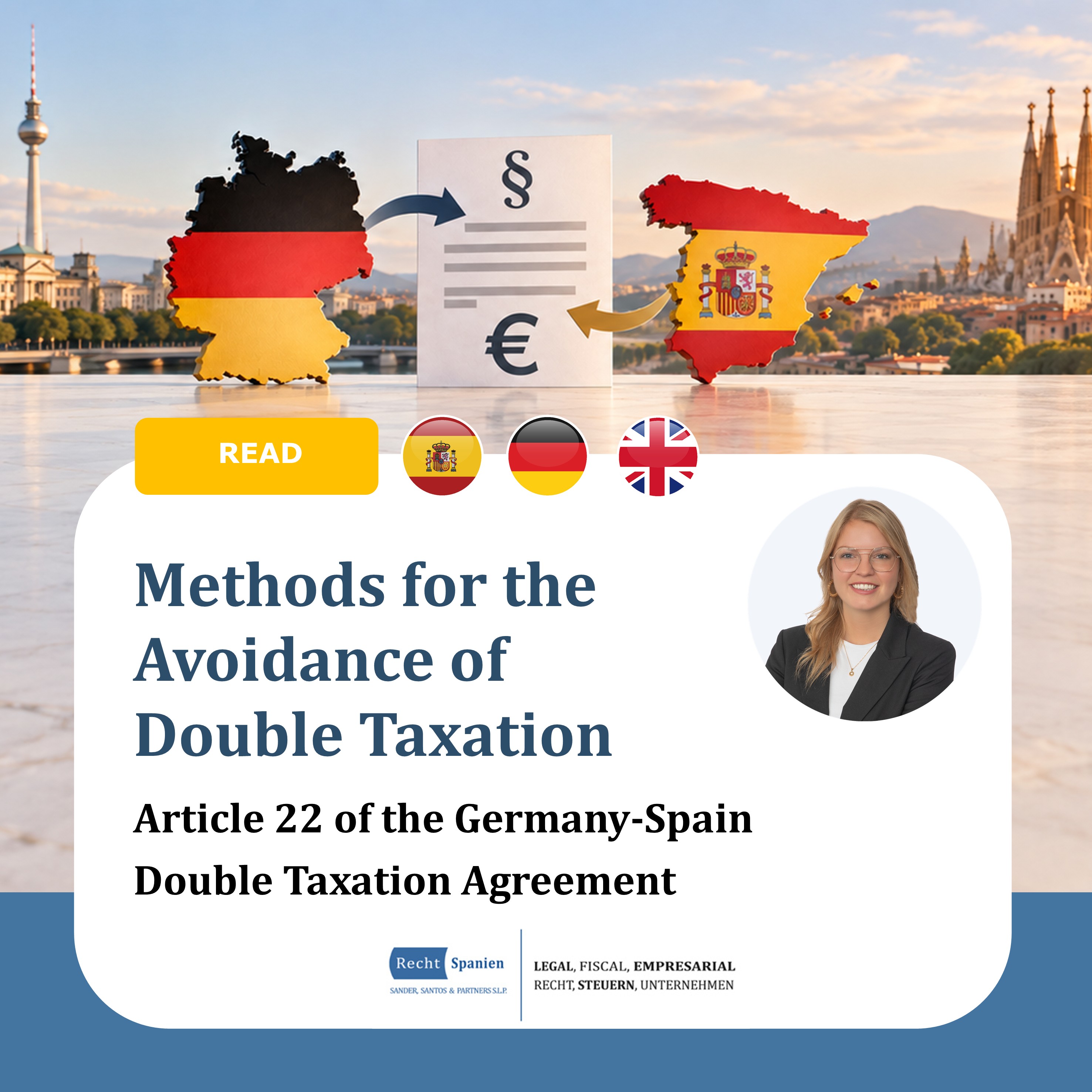
Anyone earning income in several countries is almost always faced with the question of how to ensure that this income is not taxed twice. Germany and Spain have therefore concluded a Double Taxation Agreement (DTA), which is based on the OECD Model Tax Convention. The DTA between Germany and Spain determines which country may tax certain income when a person is resident in one of the two countries but receives income from the other country.
German citizens living in Spain generally have the possibility of acquiring Spanish citizenship through permanent residence in Spain. Although German citizenship is no longer lost upon acquiring Spanish citizenship, certain aspects must be taken into account in order to retain the newly acquired Spanish citizenship alongside German citizenship.

Anyone planning a longer stay in Spain or wishing to move to Spain will need to apply for an N.I.E. In Spain, the N.I.E. serves as a tax identification number and is therefore required for virtually all administrative procedures. Although the N.I.E. is often mistakenly equated with the term “Residencia”, the N.I.E. is simply your personal tax and identification number.
Anyone living in Spain will sooner or later come across terms such as stay, residence, N.I.E., Residencia, etc. Understanding the differences between these concepts is particularly important in order to complete the various administrative procedures, registrations and formalities in due time and avoid missing any applicable deadlines.
Thanks to the digital certificate (certificado digital), a large number of administrative procedures can be carried out online from home. For example, tax advisers and lawyers can be appointed, tax returns can be filed, certificates from the municipal register can be obtained or the status of Social Security contributions can be checked. Spain is one of the most advanced EU Member States in the field of electronic public administration.
After obtaining Spanish “Residencia” and registering with the local municipal register, many people moving to Spain wonder whether and how they can register their German vehicle in Spain. In this article, we provide information on the administrative procedures to be carried out with the Spanish Tax Agency, the local council and the Spanish traffic authority, as well as on the deadline for applying for an exemption from registration tax, which in many cases can result in savings of more than €1,000.
Obtaining Spanish “Residencia” has been subject to certain requirements since 2012 (pensioners, students, employees, self-employed persons, family members of residents, etc.) and is often confused with obtaining a Spanish N.I.E. number. However, there are important differences between the two, both from a tax and an administrative perspective.
In Spain, all economically active persons are compulsorily covered by the public healthcare system. As the system is financed through taxation rather than individual health insurance contributions, the healthcare benefits provided are generally the same for everyone. You are covered from the date of registration; however, in order to obtain your Spanish health card, you must apply for it at the healthcare centre (Centro de Salud) corresponding to your place of residence. Once you are registered, eligible family members may also be included as beneficiaries without additional contributions.

Since the beginning of 2013, German citizens living in Spain have been able to deal with matters relating to both their German identity cards and passports directly through the competent German diplomatic mission or consular office. Although passport applications can also be submitted to honorary consuls, matters relating to German identity cards must be handled by one of the following consulates.

In Spain, as in Germany, the law requires motor vehicles to undergo periodic roadworthiness and emissions inspections. In Spain, this vehicle inspection is known as the ITV (Inspección Técnica de Vehículos) and may only be carried out at authorised ITV inspection stations, which vehicle owners are free to choose.

Spain is one of Europe's most popular holiday destinations and one of the countries with the highest number of restaurants. Although Spanish legislation provides a high level of consumer protection, tourists as well as residents can sometimes face unfair charges simply because they are unaware of their consumer rights when eating or drinking in bars and restaurants.
Until 2013, holders of a German driving licence residing in Spain could use their licence to drive throughout Spain without any particular restrictions. Since the beginning of 2013, however, a restriction has applied which primarily affects German citizens permanently residing in Spain and which, in certain cases, requires the exchange of the driving licence.
Under current Spanish law, every individual residing in Spain must register with the municipal population register (Padrón). Registration is particularly important for tax matters, voting in European and municipal elections, administrative procedures, as well as for determining the jurisdiction of the German Embassy in Spain.
Using your digital certificate, you can appoint us as your authorised representative before both the Spanish Tax Agency (AEAT) and Social Security (TGSS). If you do not yet have a digital certificate, our law firm can arrange one for our clients.
In addition to elections to the European Parliament, municipal elections are the only elections in which German citizens living in Spain are also entitled to vote. However, in order to exercise this right to vote, it is necessary to submit a formal declaration of your intention to vote in Spain.
N.I.E., municipal registration (Empadronamiento), vehicle registration, Social Security, driving licence exchange... Which administrative procedures need to be completed and when? Below you will find information on the most important administrative procedures, which in most cases can also be completed voluntarily before the indicated deadline.
In Spain, as a general rule, all economically active persons (employees and business owners) are required to contribute to the statutory pension and Social Security system (Seguridad Social). Although everyone contributes to the same statutory pension and Social Security system, there is an important distinction depending on the type of employment or professional relationship.
Originally associated mainly with the software and telecommunications sectors, remote work has now become common across a wide range of industries. For many employees, this creates the opportunity to fulfil what was once an unattainable dream: living in Spain while working remotely.

Depending on your involvement in the day-to-day business, both business owners and company directors are responsible for ensuring that invoices are issued correctly. Even if your accounting department independently reviews and correctly records incoming invoices, it is always advisable, even if you are not directly involved in invoicing, to review at least the larger invoices once a quarter.
While the concept of a permanent establishment plays a key role in international tax law when determining where business profits are taxed, a foreign subsidiary is a separate legal entity and therefore does not constitute a permanent establishment of its parent company. Nevertheless, even where no permanent establishment exists for tax purposes, important tax issues arise within a corporate group, particularly with regard to the distribution of profits.
Entrepreneurs and self-employed professionals planning to move their residence to Spain should consider more than just the pleasant climate and quality of life. Far more important are the tax rules applicable in both countries. A key issue in this context is the concept of a “permanent establishment”, which plays an important role in international tax law and, in particular, under the Double Taxation Agreement (DTA) between Germany and Spain. For entrepreneurs and self-employed professionals, it is essential to understand how and where their business profits are taxed in order to avoid unpleasant tax surprises.
In Spain, certain professional services are subject to withholding tax on personal income tax (IRPF withholding – Retención IRPF). This is an advance payment of income tax that is not paid directly by the professional, but instead withheld by the Spanish business client and paid to the Spanish Tax Agency.
In order for expenses to be tax-deductible as business expenses in Spain, they must generally be supported by a corresponding invoice (Factura). Unlike in other countries, such as Germany, Spain does not provide for automatically applicable flat-rate deductions, and the possibility of substantiating expenses by means of receipts (Recibos) is very limited.
Holding structures play a central role in international tax planning. They enable corporate groups to manage shareholdings efficiently, distribute profits in a tax-efficient manner and avoid double taxation.

Amazon KDP provides authors, publishers and online entrepreneurs with an easy way to self-publish books and distribute them through Amazon.
Both eBooks and printed books can be offered through the platform. Particularly in the case of paperbacks and hardcovers, this quickly raises the question:
Does the publisher sell the books directly and therefore engage in retail trade – or does the business model work differently?
For the correct tax classification in Spain, it is worth taking a closer look.

In recent years, influencer marketing has developed rapidly in Spain, not least because of the attractive lifestyle the country offers. Sunshine, beaches, Mediterranean cities and a relaxed way of life make Spain an ideal setting for lifestyle content shared daily on platforms such as Instagram, TikTok, YouTube and Twitch. Whether fashion, travel, gastronomy or fitness – many influencers take advantage of precisely these factors to create authentic content with a wide reach.
Starting a self-employed activity in Spain entails various tax obligations. From the date of registration (regardless of whether any income is generated), self-employed persons are required to file quarterly tax returns – the so-called “Modelos”. These serve, among other purposes, as advance payments towards the annual tax liability.

The GmbH & Co. KG is one of the most popular business structures in Germany, combining the tax advantages of a partnership with the limited liability of a corporation. But what happens when a partner moves their residence abroad, for example to Spain?
More and more self-employed professionals and businesses are generating revenue through digital channels – whether through downloads, online courses, subscriptions, apps or platforms such as Amazon or Etsy.
From a tax perspective, it is essential to determine whether the activity constitutes an electronically supplied (digital) service or merely a traditional service provided online. This classification determines the country in which VAT is due, the applicable VAT rate and whether the OSS scheme must be applied.
The remuneration of shareholders (shareholder remuneration) is one of the key areas reviewed by the Spanish Tax Agency. It automatically falls within the scope of related-party transactions (operaciones vinculadas), as shareholders and their companies are deemed to have a special relationship under Spanish tax law. This article explains the legal framework, provides practical guidance and highlights the most common tax risks.
Since 2013, individuals starting a self-employed activity in Spain have been able to benefit from both tax relief and reduced Social Security contributions. The €80 monthly Social Security contribution and the 20% reduction in taxable net income during the first two years can make self-employment a genuinely attractive alternative.
Particularly in cross-border e-commerce using the OSS (One-Stop Shop) scheme from Spain, businesses are often required to finance VAT for up to one year. This is because VAT must be paid separately in each country of consumption, while input VAT can generally only be reclaimed after filing the final VAT return in January of the following year. Further information about the OSS system can be found in our article: E-Commerce and the OSS (One-Stop Shop) Scheme.
In Spain, self-employed persons are generally understood to be individuals who are not employed under an employment relationship and who personally and habitually carry out an economic activity on their own account, using their own means of production and organising their activity independently. EU citizens are subject to the same rights and obligations in this respect as Spanish citizens.
The Spanish Sociedad Limitada (S.L.) is by far the most commonly used type of company in Spain. It is comparable to the German GmbH and can be incorporated with a share capital of just €3,000. This apparent simplicity, however, often leads to insufficient corporate planning and, in many cases, can ultimately contribute to the failure of the company.
Purchasing a vehicle through a Spanish Sociedad Limitada (S.L.) is a common consideration for business owners, particularly shareholder-directors. In Spain, this may offer certain tax advantages, but it also entails specific obligations. The appropriate approach depends largely on how the vehicle is used and whether it is a new purchase or a vehicle that is already privately owned by the shareholder.
Donations made to organisations qualifying under Law 49/2002 are directly tax-deductible in Spain for both individuals (Personal Income Tax) and companies (Corporate Income Tax):
The number of people living in Spain who continue to hold interests in German partnerships is steadily increasing. This particularly affects partners in a German civil-law partnership (GbR) who work from Spain or carry out their activities partly in both countries.
In the age of booming e-commerce and dynamic marketplaces, retailers are facing increasingly complex tax challenges. Particular attention must be paid to the Recargo de Equivalencia, a special regime that imposes specific VAT requirements on retailers.
The term freelancer or independent professional is commonly used to refer to a person who, on the basis of a service agreement, carries out specific assignments independently and, as a general rule, personally, without being employed by the client.

When structuring the ownership of real estate or financial assets in Spain, many investors choose to establish a company. However, where the company's principal purpose is to hold, manage or exploit real estate or other assets, it is necessary to determine whether the company carries out an economic activity or is classified as an asset-holding company (sociedad patrimonial) for Spanish tax purposes.
“I sell through Amazon.”
This is a statement we regularly hear in our advisory practice. However, on its own, it says surprisingly little about how an activity should be classified for tax purposes. Earning money through Amazon does not automatically mean that you are engaged in retail. What matters is how the specific business model actually works.

When the Panama Papers revelations shook the world in 2016, one thing became clear: offshore companies are not only used by corporations and financial experts, but also by smaller taxpayers, celebrities and politicians seeking to manage assets discreetly.

Globalisation, the digital age and the rapid expansion of e-commerce have enabled many businesses to access international markets and expand their operations across national borders.
Normally, a business owner or self-employed professional issues their own invoices. In practice, however, there are business models in which the customer or a platform issues the invoice on behalf of the business owner.
This procedure is known as Self-Billing. Under Spanish invoicing regulations, this is referred to as the issuance of the invoice by the “destinatario de la operación” (recipient of the transaction).
But is Self-Billing permitted in Spain – and what happens to the sequential invoice numbering?
The internet and the evolution of modern marketing have significantly increased the visibility and reach of businesses offering services and marketing products both nationally and throughout the European Union. This not only facilitates customer acquisition but also makes it easier to promote products and services across international markets.
Print on Demand is a popular business model, particularly among designers and online entrepreneurs. Products are not manufactured in advance and held in stock, but are generally produced only once an order has been placed.
Although this may sound straightforward, its tax classification can raise a number of questions. This is because not all Print on Demand models are the same.
Depending on how the business model is structured, the role of the entrepreneur may be completely different.
E-commerce, as a form of retail trade, is characterised by automated processes and international sales markets. Particularly within the EU, the One-Stop Shop (OSS) enables small and medium-sized businesses to sell products throughout the EU without having to establish complex and costly local administrative structures, as separate local VAT registrations are generally no longer required.
The introduction of electronic invoicing in Spain represents a significant change in the country's economic and legal framework. But what exactly does this reform involve, and which deadlines do companies and self-employed professionals need to be aware of?

Anyone who moves their residence to Spain and continues working for a company abroad may, under certain conditions, qualify for the so-called Beckham Law under Art. 93 LIRPF. In principle, this also applies where the individual continues their existing employment remotely from Spain after the move.
However, specific issues arise where the employee is also a shareholder or director of the foreign company.

Anyone who is self-employed in Spain and insured under the Régimen Especial de Trabajadores Autónomos (RETA) may, in the event of illness, generally be entitled to temporary incapacity benefits (incapacidad temporal).
If the responsible occupational insurance institution or Mutua colaboradora con la Seguridad Social is Ibermutua, various steps must be followed once the temporary incapacity begins. Below, we provide an overview of the procedure in the case of a common illness.
When choosing between registering as self-employed or setting up a company (S.L.), costs and timeframes are often important factors in addition to the legal and tax considerations. This article provides an overview of the costs involved and the time required for the respective procedures.
The main legal aspects can be summarised in terms of assets and liability, as business owners may be subject to different degrees of liability depending on the chosen business structure and may, in certain circumstances, be personally liable with their private assets.
With regard to the tax treatment of self-employed persons (personal income tax) and companies (corporate income tax), the following tax advantages of companies can be identified in simplified terms. It should be noted from the outset that the incorporation of a company should always be based on genuine business and organisational requirements and not solely on the aim of obtaining a tax advantage.
Although entrepreneurs are generally free to carry out their activity either as sole traders or through a company, there are tax-related limits governing the relationship between a company and its shareholders which, if disregarded, may result in the improper use of the tax advantages associated with a corporate structure.

Another aspect to consider when choosing the appropriate business structure is the main residence of the shareholders and, more specifically, of the company's management or, in the case of a sole trader, the business owner. In particular, businesses that provide services or trade in products (outside the traditional manufacturing sector) can often operate or provide services from different countries.

The purchase and sale of real estate in Spain involves a number of tax obligations for both the buyer and the seller. Understanding these taxes is essential not only to ensure compliance with the applicable legal requirements, but also to optimise the costs associated with the transaction.
Due diligence, a risk assessment conducted with “due care,” analyses the legal status of the property as well as any potential risks. This preliminary analysis plays an important role both in determining the value of the property and in providing legal protection for the buyer.

These preliminary agreements, often only one or two pages long, are frequently presented as a "reservation agreement", although they are in fact a legally binding preliminary contract. By signing such an agreement, you already undertake to purchase the property at a specified date under the conditions set out in the contract. A "reservation agreement" drafted and presented by a real estate agent can therefore quickly become a legal pitfall, particularly with regard to the deposit.
This article is aimed at individuals who reside within the EU and own a property in Spain. We frequently encounter property owners who use their property in Spain themselves for only part of the year and therefore decide to rent it out during the remaining periods in order to generate a better return.

Property purchases in Spain may generally be financed either through Spanish banks or through foreign banks. However, following the entry into force of the new Spanish Mortgage Act, obtaining financing from foreign lenders has become significantly more difficult in practice. In order to enhance consumer protection and prevent unfair lending practices, the new legislation requires, among other things, the electronic transmission of the mortgage documentation between the lending institution and the notary. Consequently, the lender must be connected to the digital platform established for this purpose.

In order to register the purchase of a property with the Spanish Land Registry, the purchase agreement must be executed before a Spanish notary. This can either be done by having an existing private purchase agreement notarised in the presence of both parties, or by having the purchase agreement drafted directly as a notarial deed of sale (escritura pública de compraventa).

As in Germany, owning property in Spain entails certain tax obligations and consequences. Understanding these tax aspects is important not only after purchasing a property, but particularly before the purchase, in order to make a well-informed decision regarding your property in Spain:

German citizens, as well as all other European citizens, can generally purchase property in Spain without restrictions. Real estate can be acquired either through a private purchase agreement or by means of a notarial deed. To avoid unpleasant surprises during the purchasing process, it is advisable to consider the following points carefully.

Renting out holiday apartments and rural holiday homes in Andalusia requires compliance with a number of legal requirements and registration in the relevant tourism register of the corresponding Autonomous Community. In Andalusia, a distinction must be made between urban tourist accommodation and rural holiday homes. In the latter case, registration in the Andalusian Tourism Register is mandatory.
The judgment of the Court of Justice of the European Union of 21 December 2016 makes it possible not only to claim reimbursement of amounts paid as a result of floor clauses (cláusula suelo) and disproportionate default interest, but also opens the door to claiming reimbursement of all amounts and fees paid by the borrower as a result of unfair contractual clauses contained in their mortgage agreement.

In Spain, a general distinction is made between residential tenancies and non-residential tenancies, with only residential tenancies benefiting from the specific protection provided by residential tenancy law. If a property is rented for the purpose of carrying out a commercial activity or for temporary or seasonal accommodation, it is not considered a residential tenancy and is primarily governed by the terms agreed between the parties.
Good news for individuals residing outside the EU: they may now be able to deduct expenses related to the rental of their property in Spain for tax purposes. Until now, only taxpayers residing in the EU, as well as in Iceland, Norway and Liechtenstein, were permitted to deduct expenses related to the rental of property in Spain, subject to the applicable legal requirements.

As is well known, following the reform introduced last year, it is mandatory to apply to the Land Registry for the allocation of a Rental Registration Number (NRA) for each short-term rental property.

Since May 2016, Decree 28/2016 of 2 February on holiday homes in Andalusia applies whenever your property is located in Andalusia, you regularly rent it out or intend to do so, and you advertise it for this purpose through agencies, websites, third parties, etc.

One of the ways to acquire a property in Spain is to purchase a property under construction directly from the developer. In this case, a private agreement is entered into between the buyer and the developer and a payment schedule is established. In this case, a private agreement is entered into between the buyer and the developer and a payment schedule is established.
Following the death of a family member, the heirs have a period established by law in which to complete the necessary formalities for the settlement and distribution of the assets forming part of the estate. Inheritance and Gift Tax is a State tax whose administration has been transferred to the Autonomous Communities and is regulated by Law 29/1987 of 18 December.
In order to make the best possible use of the new European rules on the choice of law applicable to succession, it is helpful to be familiar with both German and Spanish inheritance law. In this context, the differences regarding the order of succession and persons entitled to a compulsory share are particularly important, as these differences may be relevant when planning a succession according to the testator’s wishes.

The new rules on the choice of law applicable to succession make Spanish inheritance law particularly relevant for German nationals residing in Spain. In Spain, there are generally three different ways of making a valid will. Article 676 of the Spanish Civil Code distinguishes between the following three types of will, which also have equivalents under German law:
When drawing up a valid will, it is important to understand and take into account the differences relating to succession, testamentary freedom and forced heirs, as these differences can be used in different ways depending on the testator's wishes. The compulsory share of children and spouses varies considerably depending on the applicable inheritance law.
Inheritance tax planning is of particular interest to both German residents in Spain and non-residents, as appropriate tax planning can make it possible to benefit from the tax reliefs available in the different Autonomous Communities.
The new European rules on the choice of law in matters of succession make Spanish inheritance law particularly relevant for German nationals residing in Spain, as they may now choose between Spanish and German inheritance law. Depending on the testator’s wishes, the application of Spanish inheritance law may offer a number of advantages.
Due to the free movement of persons and capital within the European Union, cross-border inheritances have become increasingly common. In order to determine whether an inheritance is subject to taxation in Germany, Spain or both countries, various factors must be taken into account, such as the residence of the deceased.

Until August 2015, inheritances involving German nationals living in Spain were generally governed by German law. With the European succession law reform, which entered into force in August 2015, German nationals residing in Spain may now be subject to Spanish succession law unless they exercise the corresponding choice of law in their will.
To be entitled to unemployment benefits in Spain, you must generally be resident in Spain, be legally unemployed and have paid unemployment contributions for at least 360 days during the previous 6 years. It should be noted that the unemployment situation must not have been caused voluntarily by the employee. If you resign from your job voluntarily, you are generally not entitled to unemployment benefits.
In recent years, numerous websites have emerged offering foreign companies an attractive proposition: “Hire employees in Spain without setting up a local entity.” These platforms, often referred to as “Employer of Record (EOR),” “Global Employment,” “International Payroll” or “Remote Hiring,” act as intermediaries. Formally, the employee is employed by a local entity (the platform or one of its partners), while the foreign company ultimately organises and directs the work.

This article addresses questions concerning the employee's prior hearing in disciplinary dismissals. Although the employee's right to a hearing is provided for in Article 7 of ILO Convention No. 158 (International Labour Organization), it had not been applied in Spain until the recent ruling of our Supreme Court in its judgment of 18 November 2024.

A disguised employment relationship, also known as false self-employment, arises when a person who should legally be employed as an employee is instead required by the company to register under the Spanish Special Scheme for Self-Employed Workers (Régimen Especial de Trabajadores Autónomos – RETA) and, consequently, to pay their own self-employment social security contributions.

This article is intended to clarify the most important questions for both employers wishing to register domestic staff and employees who intend to take up employment in a private household.

Sooner or later, many employees will face this situation during their working life: they are dismissed from their job. In order to respond correctly at this critical moment, particularly with regard to outstanding salary and severance payments, it is advisable to take the following points into account.
Although fixed-term employment contracts in Spain are only permitted in certain duly justified circumstances, a large proportion of employment relationships have traditionally been entered into through fixed-term contracts, known as “contratos temporales”. Where such contracts are used fraudulently or abusively, the employment relationship may be deemed permanent.
This article examines the issues surrounding collective dismissals and addresses the main questions that commonly arise in this context. One of the key questions is when a dismissal qualifies as a collective dismissal and what legal obligations this entails for the employer.
In Spain, there are two main ways of working. You can either work as an employee (por cuenta ajena) or be self-employed (por cuenta propia or autónomo). German nationals, like all other EU citizens, are subject to the same conditions as Spanish nationals and must therefore meet the same requirements.


 (+34)
(+34)