

Private retirement provision, known in Spain as a "Plan de pensiones" (pension plan), makes it possible to defer taxation on contributions and investment returns until a later date, thereby reducing taxable income by up to €8,000 per year. Understanding the advantages and disadvantages compared with life insurance policies and investment funds is often crucial when choosing the most suitable option.
Tax reduction on contributions:
One of the greatest advantages of private pension plans is undoubtedly that contributions reduce taxable income and, consequently, the amount of tax payable. In this respect, neither the contributions nor the annual investment returns are taxed at the time they arise, as taxation is deferred until the benefits are withdrawn.
As withdrawals generally take place after retirement and retirement income is normally considerably lower than employment income during a person's working life, the applicable tax rate at the time of withdrawal is generally lower than during the contribution period.
The following example illustrates this principle, based on an annual salary of €58,000 and retirement income of €18,000:
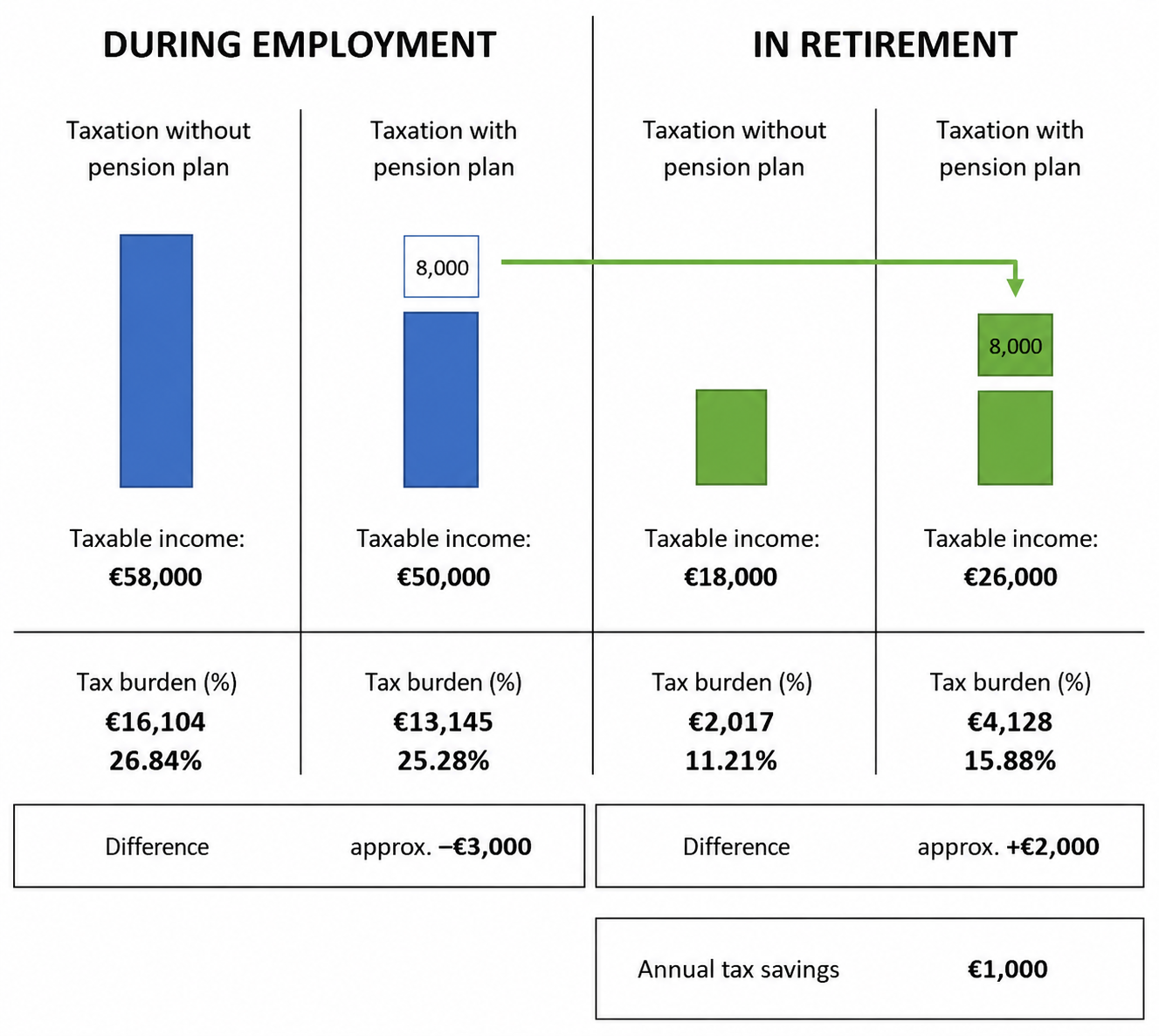
With annual tax savings of €1,000 over a period of at least 10 years, total tax savings can therefore exceed €10,000. In addition, there is a compound interest effect, as annual investment returns are not taxed until the benefits are withdrawn.
The amount and frequency of contributions can generally be chosen freely, although they usually consist of a fixed monthly contribution together with one or more additional voluntary contributions. It should be noted that total annual contributions may not exceed either the fixed amount of €8,000 or 30% of net income. Any contributions exceeding these limits cannot be deducted for tax purposes.

When can the pension plan be withdrawn?
Since February 2018, in addition to the withdrawal options already available, private pension plan contributions may be withdrawn once 10 years have elapsed since the contribution was made. A private pension plan may therefore be withdrawn in the following circumstances:
- Retirement
- Death
- 10 years after the contribution
- Dependency or long-term care
- Incapacity for work
- Serious illness
- Long-term unemployment
How can the benefits be withdrawn?
The assets accumulated over the life of the pension plan may be withdrawn as a one-off lump-sum payment, as a periodic pension or through a combination of both. In the case of periodic payments, a distinction can be made between a fixed-term pension and a lifetime pension. With a lump-sum payment, the entire accumulated amount is paid out at once, whereas a pension provides regular payments, usually monthly, which can often help reduce the overall tax burden.
Taxation of withdrawals
Withdrawals and pension payments are generally taxed as employment income and must therefore be added to other income subject to progressive taxation, such as state pension income, rental income and other taxable income. As illustrated in the example, this increases taxable income and, consequently, the applicable progressive tax rate.
If the benefits are received as a monthly or annual pension payment, the tax rate increases only moderately, as shown in the example, and will normally remain lower than the tax rate applicable during the taxpayer's working life.
If, however, the benefits are withdrawn as a one-off lump-sum payment, the entire amount is taxed in the tax year in which it is received. As a result, the average tax rate for that year may increase significantly, and the marginal tax rate may in many cases reach the highest applicable tax bracket.
With regard to these one-off lump-sum withdrawals, it should be noted that contributions made up to the end of 2006 continue to benefit from a 40% tax reduction if the lump-sum withdrawal is requested upon retirement or within the following two years. In this case, the remaining 60% continues to be fully taxable.
If a future lump-sum withdrawal is being considered from the outset, other investment products, such as life insurance policies and investment funds, should also be taken into consideration.

Differences compared with life insurance
If benefits from a private pension plan become payable as a result of the death of the policyholder and the right to receive the benefits passes to the beneficiaries, usually the spouse or descendants, the beneficiaries must also declare the amounts received as employment income. Their individual tax rate must therefore also be taken into account.
In the case of a life insurance policy, however, the amounts received are generally subject to inheritance tax. In such cases, particular attention must be paid to the habitual residence of the heirs, as inheritance tax can vary considerably depending on the Autonomous Community. For example, direct heirs in Andalusia may benefit from an exemption of up to €2 million per heir, while in Madrid a 99% reduction in the tax may apply.
Differences compared with investment funds
As contributions to investment funds do not qualify for a reduction in the tax burden at the time of investment, the amount originally invested is not taxed again upon withdrawal. The tax payable upon withdrawal is generally limited to capital gains tax, which in Spain is taxed at rates ranging from 19% to 23%, depending on the amount. It should be noted that only the difference between the total amount invested and the amount received upon withdrawal is subject to taxation. Therefore, if a future lump-sum withdrawal is planned from the outset, an investment fund may be a suitable investment product.
Our law firm will be pleased to assist you in analysing your individual circumstances, handling the necessary administrative procedures on your behalf and preparing and filing the relevant tax returns. If you are interested or have specific questions regarding this matter, please feel free to contact us by email or telephone.
Author:

Christoph Sander
Lawyer and Tax Advisor
CEO, Partner, Director
info@sspartners.es
Tel: (+34) 951 12 13 06
Facebook I LinkedIn I Amazon
Stay informed! Follow us on:


 (+34)
(+34)