



Moving to Spain can provide significant tax advantages for many employees and company directors. Individuals relocating to Spain for employment purposes may opt to have their employment income taxed as a non-resident at a fixed tax rate of 24% for a period of six tax years.

Exit taxation is a key component of German tax law. It applies to individuals who transfer their tax residence abroad while holding certain shareholdings. The rules are primarily governed by Section 6 of the German Foreign Tax Act (Außensteuergesetz – AStG) and Section 17 of the German Income Tax Act (Einkommensteuergesetz – EStG). Their purpose is to tax the increase in value of these shareholdings—commonly referred to as hidden reserves—before Germany loses its taxing rights. As of 1 January 2025, the new Section 19(3) of the German Investment Tax Act (Investmentsteuergesetz – InvStG) also extends exit taxation to certain investment fund units.
Our law firm regularly advises clients who relocate their residence from Germany to Spain. In such cases, one question frequently arises: Which country is entitled to tax worldwide income during the year of relocation – Germany or Spain?
In Spain, a general distinction is made between late-payment or late-filing surcharges (Recargos) and fines or penalties (Multas). With regard to the former, it is particularly important to point out that, unlike in some other countries, these surcharges are not based on culpable or negligent conduct by the taxpayer, but arise solely as a result of the late fulfilment of a tax obligation.
Moving to a new country often raises important tax questions, particularly regarding the taxation of retirement savings and pension benefits. In this article, we examine the tax treatment of the Swiss Three-Pillar Pension System when relocating from Switzerland to Spain.
Pensioners who wish to relocate their residence to Spain may generally receive their pension either into a German or a Spanish bank account. Where your pension is taxable depends primarily on when you started, or will start, receiving your pension. In certain cases, it may be necessary to file an income tax return in both Germany and Spain.
To understand Spanish Personal Income Tax, it is particularly important to distinguish between the average tax rate, the marginal tax rate and the top marginal tax rate. Unlike some other countries, Spain does not use a tax-class system. Personal circumstances are therefore not taken directly into account when determining the applicable tax rate. Instead, tax is calculated progressively using a system of tax brackets.
Property ownership by non-residents in Spain is subject to both Property Tax (IBI) and Non-Resident Income Tax (IRNR). If your tax residence is outside Spain, both rental income and the so-called deemed income from property ownership (imputación de rentas inmobiliarias) must be declared and taxed under the Spanish Non-Resident Income Tax regime.
An increasing number of pensioners who live in Spain or have relocated to Spain receive letters from the Neubrandenburg Tax Office informing them about the possibility of applying for unlimited tax liability in Germany (Behandlung als unbeschränkt steuerpflichtig). As these letters are frequently misunderstood, this article briefly explains the implications of applying for unlimited tax liability and the tax risks associated with such an application.

The “Framework for the Automatic Exchange of Readily Available Information on Immovable Property” (IPI MCAA) is intended to enable tax administrations to automatically exchange information on immovable property held across borders – including ownership, transactions and ongoing income.

Private retirement provision, known in Spain as a "Plan de pensiones" (pension plan), makes it possible to defer taxation on contributions and investment returns until a later date, thereby reducing taxable income by up to €8,000 per year. Understanding the advantages and disadvantages compared with life insurance policies and investment funds is often crucial when choosing the most suitable option.

Spain encourages investment in the energy efficiency of residential buildings through attractive tax deductions under Personal Income Tax (IRPF). One particularly relevant provision concerns energy-efficiency renovation measures, such as the installation of solar panels. Below, we provide an overview of the current tax requirements, applicable deadlines and available deductions.
As a general rule, domicile should be equated with the concept of “residence”. If you are domiciled in Spain, for administrative and tax purposes you will, in principle, be considered a resident or “tax resident”. However, you should take care to ensure that your holiday home does not inadvertently become your main tax residence, since for those who unknowingly become subject to unlimited tax liability, their supposed “second home” can quickly turn into a tax trap.
Particularly in times of economic uncertainty, when relocating abroad is increasingly used as a tax planning strategy, one question remains: How can a country protect its tax base against the emigration of taxpayers, and to what extent are such mechanisms legally permissible? Spanish exit taxation, also referred to as the exit tax, was introduced by Law 26/2014 of 27 November 2014 as part of the reform of the Spanish Personal Income Tax Act through Article 95 bis of the Personal Income Tax Act (LIRPF). Its purpose is to prevent tax avoidance resulting from the transfer of tax residence abroad.

The sale of real estate and land may have significant tax consequences, which vary depending on the country involved. While capital gains arising from the disposal of property are generally subject to taxation in Spain, German tax law provides for certain exemptions under specific circumstances. Careful planning of the timing of the sale can therefore result in substantial tax advantages.
Whether wealth tax is payable in Spain, and how much, depends on the region. In response to the abolition of wealth tax in several Spanish regions, the State introduced a new “solidarity tax”, which applies whenever no wealth tax is payable and assets exceed €3,000,000 (€3,700,000 including the tax-free allowance). In some regions, however, wealth tax applies from as little as €500,000.
An increasing number of companies operate internationally and temporarily assign employees to work abroad. To avoid double taxation in such cases, Article 7(p) of the Spanish Personal Income Tax Act (IRPF) provides for a special tax exemption. This provision allows certain employment income earned abroad to be received tax-free, provided that the applicable requirements are met.
Since 2012, individuals who are tax resident in Spain (Residentes) have been required to report certain assets held abroad. This reporting obligation is fulfilled by submitting a separate information return, independent of the annual tax return. Failure to comply, where the statutory thresholds are exceeded, may result in substantial financial penalties.
Many people who relocate to Spain continue to hold bank accounts, securities portfolios or brokerage accounts in Germany. While this may seem unproblematic at first glance, it often results in a significant tax issue in practice: German banks continue to withhold German capital gains tax, even though such tax is generally no longer due once the account holder has become a tax resident of Spain.

In order to address the issues associated with the anonymity of cryptocurrencies, Spain has introduced measures aimed at strengthening tax control over virtual currencies. The introduction of the obligation to report cryptocurrencies held or managed abroad through Modelo 721 in 2023 represented a further step in this direction.
International taxation refers to the measures and procedures adopted by countries to regulate the taxation of cross-border transactions and ensure fair taxation. In Spain, as in other countries, international taxation is based on international agreements, EU directives and national legislation.

Since the 2024 tax year, Spain has introduced an important change to its tax legislation that makes donations to non-profit organisations significantly more attractive from a tax perspective, particularly for companies. The key aspect of the new rules is that both individuals and companies can deduct qualifying donations directly from their tax liability (“deducción en cuota”), rather than merely treating them as an expense when calculating the taxable base. The aim of the reform is to provide greater incentives for both private and corporate social engagement. These changes are based on the reform of Law 49/2002, introduced by Royal Decree-Law 6/2023 and effective as of 1 January 2024.
Individuals who are not resident in Spain are generally required to pay tax on their worldwide income in their country of tax residence and are only subject to taxation in Spain in respect of income and assets located in Spain. Real estate ownership is particularly relevant in this context, as it may give rise to both income tax and property tax obligations.
Particularly since the introduction of Modelo 721, many taxpayers resident in Spain have been asking how gains and losses arising from the purchase and sale of virtual currencies should be taxed in their personal income tax return.
By filing a voluntary tax return, you may be entitled to a tax refund that would otherwise remain with the tax authorities. In Spain, employees are exempt from the obligation to file a tax return if their annual income consists exclusively of employment income and is below €22,000.
Individuals who are tax resident in Spain and receive benefits from a German occupational pension scheme must generally also consider the Spanish tax treatment of those benefits. One particularly important question is whether a lump-sum payment is treated as employment income for Spanish Personal Income Tax (IRPF) purposes and whether a tax reduction may be available.
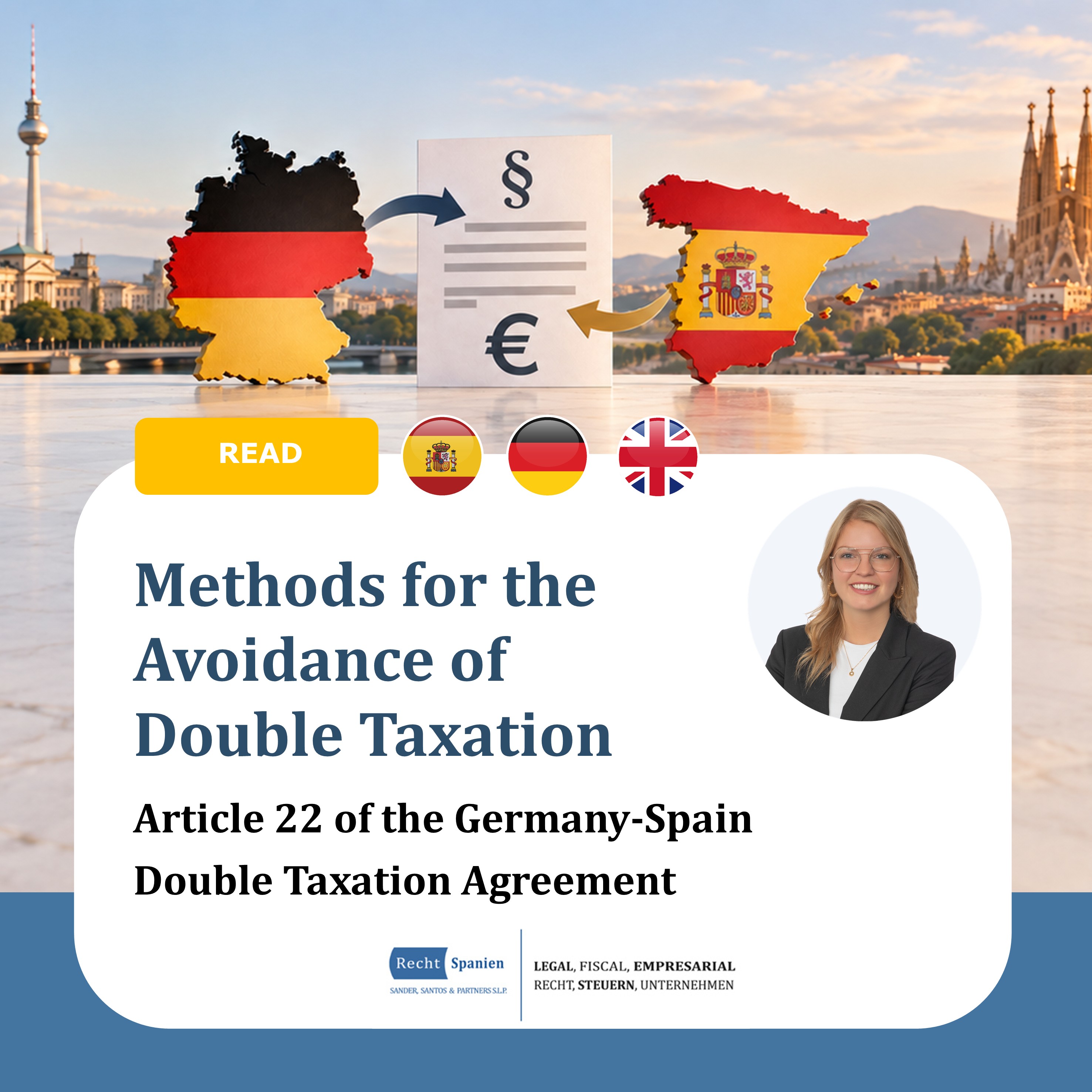
Anyone earning income in several countries is almost always faced with the question of how to ensure that this income is not taxed twice. Germany and Spain have therefore concluded a Double Taxation Agreement (DTA), which is based on the OECD Model Tax Convention. The DTA between Germany and Spain determines which country may tax certain income when a person is resident in one of the two countries but receives income from the other country.


 (+34)
(+34)