


Particularly since the introduction of Modelo 721, many taxpayers resident in Spain have been asking how gains and losses arising from the purchase and sale of virtual currencies should be taxed in their personal income tax return.

Virtual currencies such as Bitcoin and Ethereum have become increasingly popular in recent years. Various tax aspects must be taken into account when buying and selling digital currencies, particularly where the transactions are carried out outside the scope of a business activity. Detailed information on the new Modelo 721 (cryptocurrency reporting obligation) can be found in our article: Cryptocurrencies Held Abroad: The New Modelo 721.
The most important tax rules are summarised below.
1. Exchange of Virtual Currencies for Legal Tender
The disposal of virtual currencies in exchange for euros or other legal tender gives rise to a capital gain or loss. The gain or loss is calculated as the difference between the sale price in euros and the acquisition price, taking into account exchange rates, transaction costs and taxes directly related to the transaction. The capital gain or loss must be calculated separately for each transaction. The FIFO method (First In, First Out) applies, meaning that the virtual currencies acquired first are deemed to be the first ones sold.
Capital gains or losses resulting from the transfer of virtual currencies must be reported in the personal income tax return and are included in the savings tax base. There is a specific section entitled “Capital gains and losses arising from the transfer or exchange of virtual currencies by individuals”. The corresponding transactions must be reported in detail in this section to ensure their correct tax treatment.
The relevant time for taxation is the date on which the virtual currencies are transferred, regardless of when the sale proceeds are actually received. This means that the gain or loss is considered realised as soon as the virtual currency is transferred.
The tax treatment of virtual currencies requires careful record-keeping and documentation of all transactions. Taxpayers should ensure that all transfers of virtual currencies are accurately tracked and that the date on which the gain or loss is realised is correctly determined. It is also important to include all relevant information in the personal income tax return in order to avoid potential adverse tax consequences.

2. Exchange of One Virtual Currency for Another
Under Article 1,538 of the Spanish Civil Code (Código Civil), the exchange of one virtual currency for another constitutes an exchange agreement. Under such an agreement, each party undertakes to transfer one asset in order to receive another.
Such an exchange results in a change in the taxpayer's assets and therefore gives rise to a capital gain or loss, calculated on the basis of the difference between the acquisition value of the virtual currency transferred and the market value of the currency received. The FIFO method (First In, First Out) also applies in this case, meaning that the units of a virtual currency acquired first are deemed to be the first units sold or exchanged. Consequently, the holdings are taken into account in the order in which they were acquired when calculating gains or losses.
These gains or losses are recognised at the time the virtual currencies are exchanged. It is therefore essential to accurately document both the exact date of the transaction and the market values of the currencies involved.
As with the exchange of virtual currencies for legal tender, the resulting capital gains or losses are included in the savings tax base. These transactions must therefore also be reported in the taxpayer's personal income tax return. Taxpayers are required to provide detailed information on all relevant transactions in order to ensure the correct calculation of their tax liability.

Calculation and Documentation of the Relevant Data
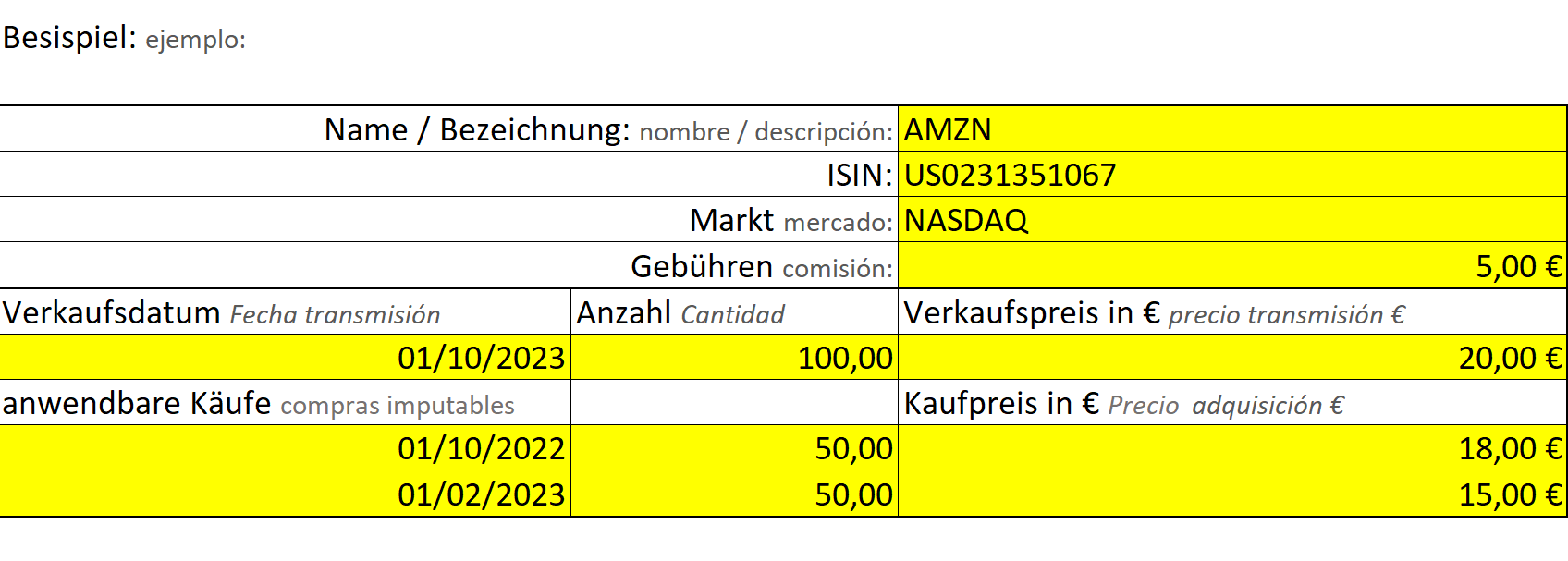
As these are gains or losses arising from disposal transactions, each individual sale must be reported separately. For example, if Amazon shares were sold in 2023 and some of those shares had been acquired in 2022 and others in 2023, all acquisition and disposal data would be required in order to calculate the resulting gain. It is important that these amounts are stated in euros. Brokers and banks are required to provide this information. The relevant data may be obtained either from a chronological transaction history or from a table summarising the information for each individual sale:
It should be noted that in Spain the tax authorities do not generally issue individual tax assessments following the filing of a self-assessed tax return. Supporting documents, calculations and evidence are therefore normally requested by the tax authorities only in the event of a tax review or inspection.
Conclusion
Dealing with virtual currencies requires a thorough understanding of the applicable tax rules and careful documentation of all transactions. Correct application of the FIFO method, accurate determination of market values and compliance with the relevant reporting obligations are essential in order to minimise tax risks and comply with the applicable legal requirements.
Our law firm will be pleased to assist you in analysing your individual circumstances, handling the necessary administrative procedures on your behalf and preparing and filing the relevant tax returns. If you are interested or have specific questions regarding this matter, please feel free to contact us by email or telephone.
Author:

Rike Füllgraf
Tax Advisor
info@sspartners.es
Tel: (+34) 951 12 13 06
Facebook I LinkedIn I Amazon
Stay informed! Follow us on:


 (+34)
(+34)