

Spain encourages investment in the energy efficiency of residential buildings through attractive tax deductions under Personal Income Tax (IRPF). One particularly relevant provision concerns energy-efficiency renovation measures, such as the installation of solar panels. Below, we provide an overview of the current tax requirements, applicable deadlines and available deductions.
Legal basis and applicable period
The tax benefit is established in Additional Provision No. 50 of the Spanish Personal Income Tax Law (Ley del IRPF). This provision was amended by Article 16 of Royal Decree-Law 8/2023 of 27 December 2023 (published in the Spanish Official State Gazette (BOE) on 28 December 2023).
As a result of this legislative amendment, the period of application of the tax benefit was extended until 31 December 2025. In principle, payments for energy-efficiency renovation works made between 6 October 2021 and 31 December 2025 are eligible.
Which measures qualify for the tax deduction?
In principle, investments that result in a demonstrable improvement in the energy efficiency of a building are eligible for the deduction. Qualifying energy-efficiency measures include, in particular, the installation of systems using renewable energy (e.g. photovoltaic or solar thermal systems), measures to improve the thermal insulation of buildings (façades, roofs, windows and doors), as well as the replacement or optimisation of heating, cooling and hot-water systems using energy-efficient technologies. In all cases, the measure must result in a demonstrable improvement in the building's energy efficiency, which must be evidenced by an Energy Performance Certificate.
For the tax deduction to apply, proof of the improvement in energy efficiency by means of Energy Performance Certificates (Certificado de Eficiencia Energética) is mandatory. As a general rule, two certificates are required: one before the work begins and another after its completion. Both certificates must be issued by an authorised technician and registered with the competent authority of the relevant Autonomous Community.
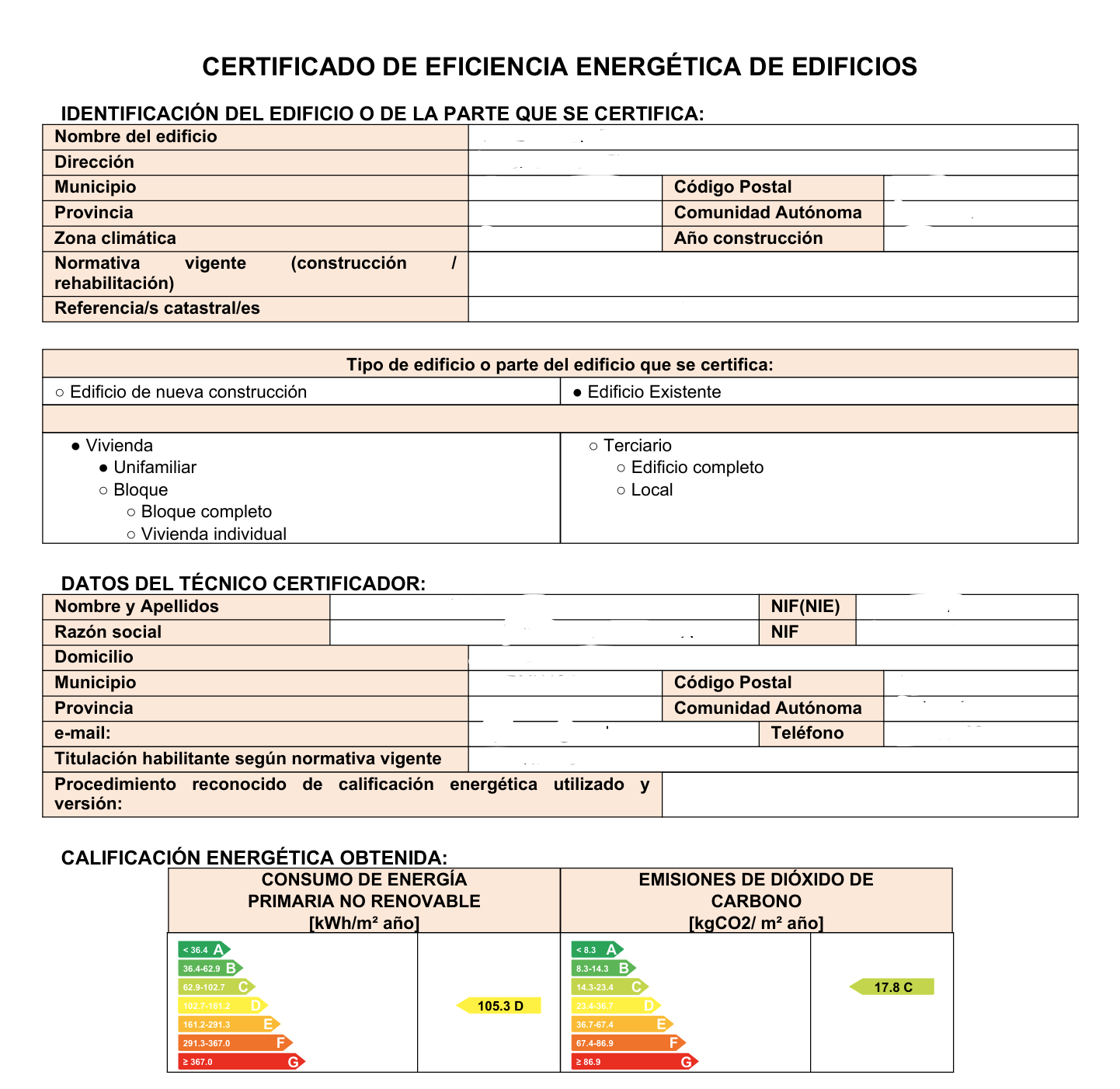
Only duly registered certificates are recognised by the Spanish Tax Agency:
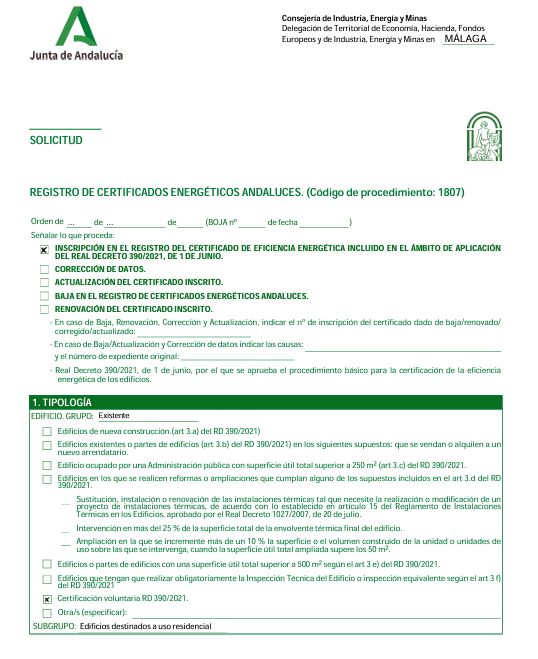
The law requires at least one of the following criteria to be met:
- A reduction in non-renewable primary energy consumption of at least 30%, or
- An improvement in the building's energy efficiency rating to class A or B compared with the original certificate.
Without such documented improvement, the tax deduction cannot be claimed. The relevant Energy Performance Certificate must be issued before 1 January 2026.

Which costs are tax-deductible?
The tax benefit covers not only the installation costs themselves, but also all necessary expenses directly related to the measures, including:
- Installation and material costs
- Planning and project costs
- Construction management and technical supervision
- Costs of obtaining the Energy Performance Certificates
However, costs relating to systems that use or replace fossil fuels are not eligible for the deduction.
In addition, cash payments are excluded. For tax purposes, only payments made by bank transfer, credit or debit card, cheque or bank deposit are recognised.
Taking grants and subsidies into account
If the taxpayer receives public grants or subsidies, these amounts must be deducted from the assessment base used to calculate the tax deduction.
If a grant or subsidy is awarded retrospectively, any tax deduction already claimed must subsequently be adjusted in the corresponding tax year.
Amount of the tax deduction
The tax deduction amounts to 60% of the eligible expenditure.
- Maximum of €5,000 per year and tax return
- Unused amounts may be carried forward and claimed in the following four years
The cumulative maximum limit is €15,000 per taxpayer.

Practical example: Timing of the Energy Performance Certificate and allocation of the tax deduction
Initial situation
A married couple (J.G. and T.K.) carries out energy-efficiency renovation works on their jointly owned property. The payments are made as follows:
1. December 2024: €8,000
2. March 2025: €2,000
3. May 2025: €2,000
However, the final Energy Performance Certificate confirming the required improvement is not issued until 2025.
Tax year 2024: No tax deduction available
Although payments for the energy-efficiency measures were already made in 2024, no tax deduction can be claimed for the 2024 tax year.
The reason is that the tax deduction may only be claimed in the year in which the final Energy Performance Certificate is issued. Since the certificate is not issued until 2025, the deduction is deferred in full to that year.
Tax year 2025: Application of the tax deduction
The total eligible costs amount to:
€8,000 (2024)
€4,000 (2025)
Total: €12,000
As the property is jointly owned, the assessment base is divided between both spouses where they file separate tax returns.
Separate tax returns (2025)
For each spouse:
Assessment base: €12,000 ÷ 2 = €6,000
Annual maximum amount: €5,000
Tax deduction: €5,000 × 60% = €3,000
Unused remaining amount: €1,000, which may be carried forward to subsequent years
Remaining cumulative maximum limit: €10,000
Joint tax return (2025)
Total assessment base: €12,000
Annual maximum amount: €5,000
Tax deduction: €5,000 × 60% = €3,000
Unused remaining amount: €7,000, which may be carried forward
Remaining cumulative maximum limit: €10,000
Tax year 2026: Deduction of the remaining amounts
Amounts not used in 2025 may continue to be deducted, depending on the chosen method of taxation.
For separate tax returns:
Each spouse may claim their remaining amount (e.g. €1,000) → tax deduction of €600.
For a joint tax return:
Up to €5,000 per year may be taken into account, provided that the cumulative maximum limit (€15,000) has not yet been reached.
Unused amounts may be carried forward for a total of up to four subsequent years (e.g. until 2027).
Our law firm will be pleased to assist you in analysing your individual situation, carrying out any necessary administrative procedures and assisting you with the preparation and filing of the relevant tax returns. If you are interested or have any specific questions regarding this matter, please feel free to contact us by email or telephone.
Author:

Rike Füllgraf
Tax Advisor
info@sspartners.es
Tel: (+34) 951 12 13 06
Facebook I LinkedIn I Amazon
Stay informed! Follow us on:


 (+34)
(+34)