

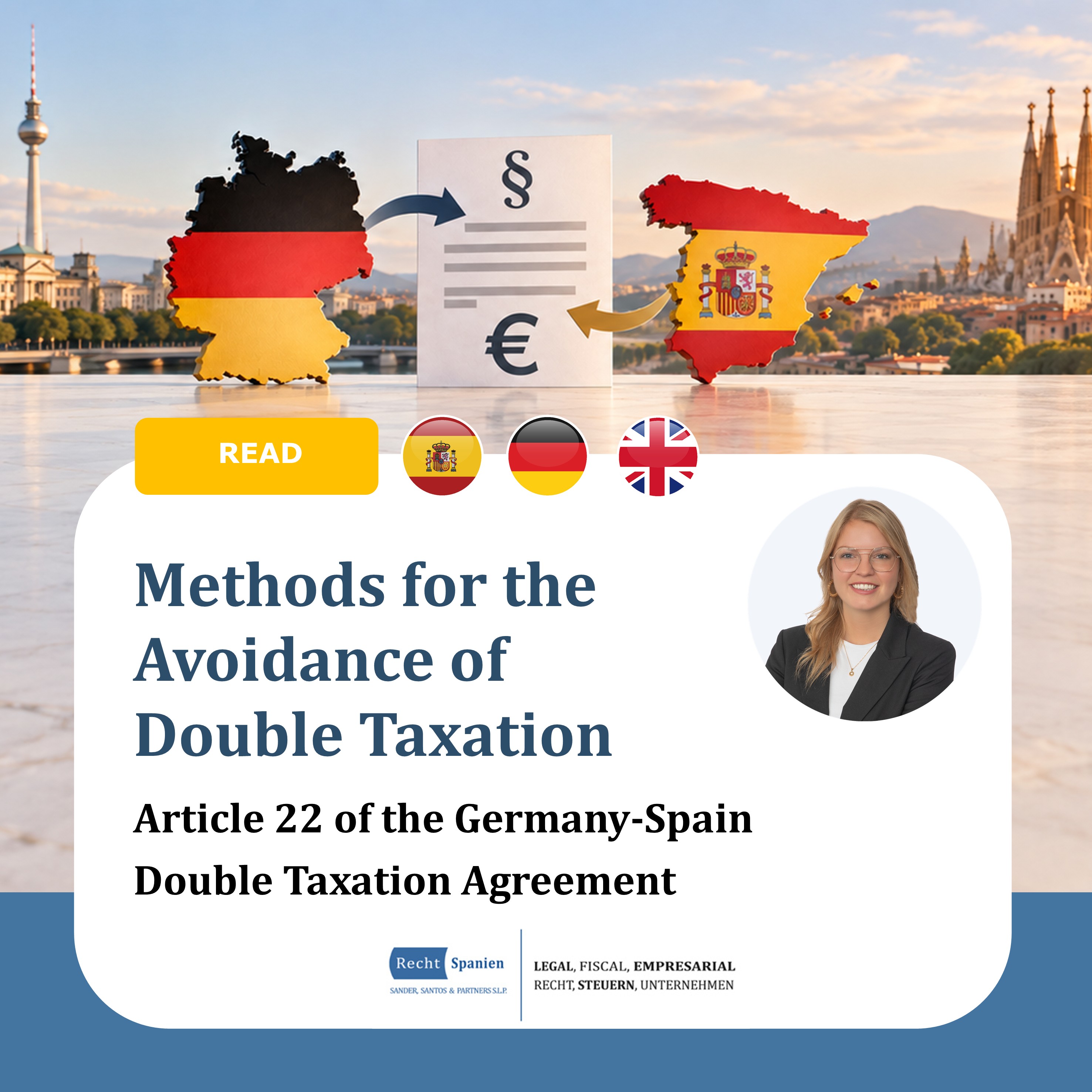
Anyone earning income in several countries is almost always faced with the question of how to ensure that this income is not taxed twice. Germany and Spain have therefore concluded a Double Taxation Agreement (DTA), which is based on the OECD Model Tax Convention. The DTA between Germany and Spain determines which country may tax certain income when a person is resident in one of the two countries but receives income from the other country.
The Agreement has two main objectives:
- Avoidance of double taxation – ensuring that the same income is not taxed twice,
- Prevention of tax avoidance – through clear allocation rules determining which country may tax which income.
The current version of the Agreement dates from 2011 and has been applicable since 1 January 2013.
Article 22 of this DTA determines which method is to be applied to avoid double taxation in the two contracting states. In principle, there are two mechanisms: the exemption method and the credit method.
The exemption method
Under the exemption method, foreign income is exempt from tax in the country of residence, but it is taken into account for the purposes of determining the applicable tax rate under the progression clause. This means that it increases the tax rate applied to the remaining income.
Example:
An employee initially lives and works in Germany and earns employment income of EUR 60,000 there. In September, he moves to Spain and starts a new job there, earning a further EUR 20,000 by the end of the year.
In Spain, the employee is initially treated as a non-resident for this period. Therefore, tax of 19% is generally withheld from his Spanish salary. The tax is paid monthly by his Spanish employer.
In Germany, when applying the exemption method, the EUR 20,000 of income earned in Spain is not taxed directly again. However, it is taken into account when determining the applicable tax rate under the progression clause.
In simplified terms, the German income of EUR 60,000 and the Spanish income of EUR 20,000 are added together for this purpose. The applicable German income tax rate is determined on the basis of total income of EUR 80,000. This higher tax rate is then applied exclusively to the EUR 60,000 of income taxable in Germany.
The Spanish income of EUR 20,000 is therefore not directly taxed in Germany, but it increases the tax rate applicable to the German income.

The credit method
The credit method works differently: foreign income is included in the tax assessment in the country of residence. To avoid the same income being taxed twice, the tax already paid in the source country may be credited against the tax due in the country of residence. The amount credited may not exceed the amount of tax that would be payable in Spain on this income. In practice, this means that the taxpayer always bears at least the higher tax burden of the two countries.
Example:
A taxpayer lives in Spain throughout the entire year and is tax resident there. At the same time, he owns real estate in Germany which he rents out and from which he receives rental income.
As the properties are located in Germany, Germany has the right to tax the rental income derived from them. The taxpayer must therefore initially pay tax on the rental income in Germany.
However, since he is tax resident in Spain, he is generally subject to taxation there on his worldwide income. The German rental income must therefore also be declared in the Spanish income tax return and is taken into account when calculating Spanish income tax.
To ensure that the same income is not fully taxed twice, the credit method is applied: the tax paid in Germany on the rental income may be credited against the Spanish tax attributable to this income.
If, for example, the Spanish tax attributable to this income is higher than the tax already paid in Germany, the corresponding difference must generally still be paid in Spain. If, on the other hand, the tax paid in Germany is higher than the Spanish tax attributable to this income, the credit is limited to the amount of the Spanish tax. Any excess tax paid in Germany is not refunded in Spain.

Application of the methods in Germany
Germany generally applies the exemption method when the Agreement assigns the right of taxation to the other country. Typical cases include:
- Income from real estate in Spain: Under Art. 6 of the DTA, Spain, as the country in which the property is situated, may tax this income, while Germany exempts it under Art. 22, subject to progression.
- Income from permanent establishments in Spain: The exemption method also applies where a German entrepreneur has a permanent establishment in Spain.
- Employment income in Spain: If an employee is resident in Germany but works temporarily in Spain for a Spanish employer, Spain may tax this income and Germany exempts it from tax, again subject to progression.
Germany applies the credit method only in exceptional cases, for example, to income from dividends, interest or royalties. In these cases, the taxpayer pays the full tax in Germany and, where withholding tax has been levied in Spain, this tax may be credited against the German tax.
Application of the methods in Spain
Spain takes the opposite approach. For income taxed in Germany, the credit method is predominantly applied. A taxpayer resident in Spain who receives income from Germany must declare this income in Spain but may credit the German tax against his Spanish income tax. This applies in particular to:
- Income from real estate in Germany. Germany has the primary right to tax rental income. The tax paid in Germany is credited against the Spanish tax.
- Investment income subject to withholding tax in Germany. Spain credits the withholding tax deducted in Germany against Spanish tax. Example: In the case of dividends from Germany, Germany generally has the right to levy withholding tax of up to 15%. The withholding tax deducted in Germany is subsequently credited against the Spanish tax attributable to the dividends. (See also: article on incorrectly withheld capital gains tax)
- Permanent establishment income in Germany, where an entrepreneur resident in Spain operates a permanent establishment in Germany.
- Income from interests in German partnerships. If a taxpayer resident in Spain holds an interest in a German partnership without personally carrying out activities for the partnership in Spain, the income attributed to him may be taxable in Germany. The tax paid in Germany is generally credited against the Spanish tax attributable to this income. (See also: taxation of a GbR)
The exemption method is the exception in Spain. As a general rule, Spain requires the worldwide income of its tax residents to be subject to Spanish taxation, with a credit being granted only to the extent of tax already paid abroad.
In Spain, a tax exemption may apply in particular to employment income under Art. 7 p) LIRPF. Under this provision, income from work actually performed abroad may, subject to certain conditions, be exempt from Spanish income tax up to an amount of EUR 60,100 per year.
Example: An employee works on site in Germany until March and subsequently moves to Spain, where he becomes tax resident in the relevant year. Provided that the requirements of Art. 7 p) LIRPF are met, the employment income attributable to the work performed in Germany may be exempt from tax in Spain up to an amount of EUR 60,100, subject to progression.
Conclusion
The DTA between Germany and Spain ensures that cross-border income is not fully taxed in both countries. The first step is to determine which country the DTA assigns the right to tax the respective type of income. Only in the second step does the question arise as to how the country of residence avoids the resulting double taxation.
Article 23 of the Spain–Germany DTA is key to avoiding double taxation. While Germany primarily applies the exemption method with progression, Spain relies almost entirely on the credit method.
Although foreign income is often described as “tax-exempt” under the exemption method, this does not mean that such income has no tax consequences. Through the progression clause, it is taken into account when determining the tax rate and may therefore result in a higher tax rate being applied to the remaining taxable income.
Under the credit method, on the other hand, foreign income is included directly in the tax assessment. Tax already paid abroad is merely credited against the tax due in the country of residence.
Which method actually applies always depends on the type of income, tax residence and the specific provisions of the DTA. In addition, national special provisions may apply, such as the tax exemption for certain employment activities carried out abroad under Art. 7 p) LIRPF.
Particularly in the case of a move between Germany and Spain or income from real estate, investments, permanent establishments or business interests, it is therefore not sufficient to consider only where the income was earned or has already been taxed. Instead, it must be determined for each type of income which country has the right to tax it and how the other country avoids double taxation.
Our law firm will be pleased to assist you in analysing your specific situation, handling the necessary administrative procedures on your behalf and assisting you with the filing of the relevant tax returns. If you are interested or have specific questions on this topic, please feel free to contact us by email or telephone in German.
Author:

Rike Füllgraf
Tax Advisor
info@sspartners.es
Tel: (+34) 951 12 13 06
Facebook I LinkedIn I Amazon
Stay informed! Follow us on:


 (+34)
(+34)