

The new European rules on the choice of law in matters of succession make Spanish inheritance law particularly relevant for German nationals residing in Spain, as they may now choose between Spanish and German inheritance law. Depending on the testator’s wishes, the application of Spanish inheritance law may offer a number of advantages.
Heirs and Legatees
Under Spanish law, the testator must appoint at least one heir in the will. If neither an heir nor a legatee is designated in the will, and the appointment of an heir cannot otherwise be inferred from the will, the rules of intestate succession will apply. Similar principles also apply under German law where the testator appoints only one heir and limits the appointment to a fraction of the estate, or where the appointment of several heirs to fractional shares does not exhaust the entire estate. Therefore, under both German and Spanish law, it is advisable to identify the heirs as precisely as possible and expressly designate them as such.
A) Heirs
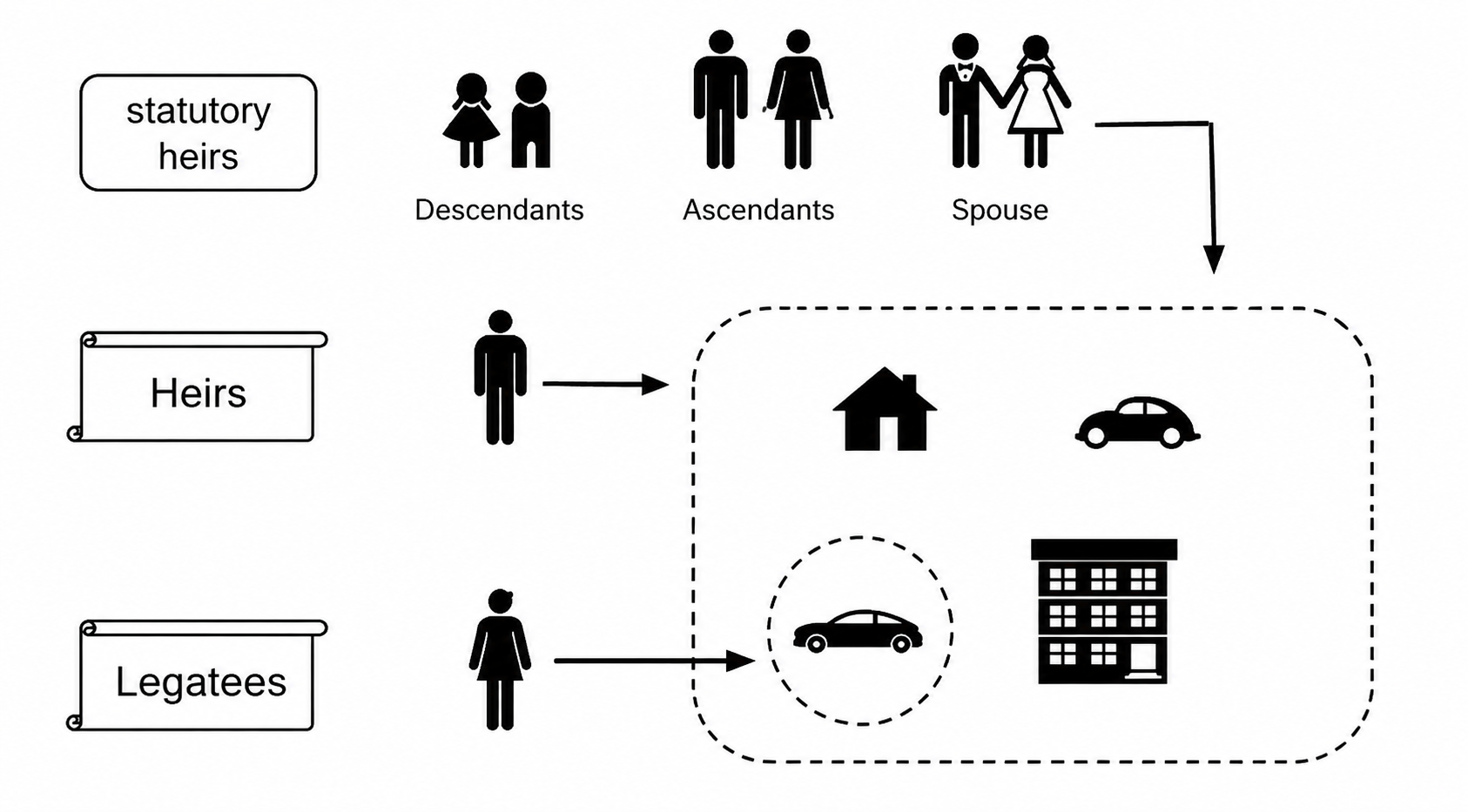
The Spanish Civil Code distinguishes between heirs and legatees depending on whether they inherit the estate as a whole or a share thereof, or whether a specific asset is attributed to them. Under German law, a testamentary disposition is likewise regarded as an appointment of an heir where the testator leaves his or her estate, or a fraction thereof, to a beneficiary. This also applies even if the beneficiary is not expressly referred to as an heir.
B) Legatees
If, however, the testator leaves a specific asset to a person, that person is considered a legatee. A legatee is not an heir and, consequently, the acceptance or renunciation of the legacy does not entail personal liability for the debts of the estate. Similarly, the German Civil Code provides that, in case of doubt, a person should not be regarded as an heir where only individual assets have been left to that person. As in the previous case, the terminology used by the testator is irrelevant, even where the legatee has been referred to as an heir.
Thus, under both Spanish and German inheritance law, it is possible to appoint not only heirs — where the testator leaves his or her estate or a fraction thereof to a beneficiary — but also so-called “legatees”, to whom a specific asset is left.

Acceptance, Renunciation and Liability
Unlike under German inheritance law, under Spanish inheritance law an inheritance must either be accepted or renounced. During the period between the testator’s death and acceptance by the heirs, the estate remains in a state known as a “vacant estate” (herencia yacente) and temporarily has no definitive owner. In Germany, by contrast, the estate passes directly to the heir or heirs, who then have the option of renouncing it within a prescribed period. Under German law, therefore, once the relevant period has expired without renunciation, the inheritance is deemed to have been accepted.
Time Limit for Acceptance or Renunciation
Since in Spain the estate remains in a state of abeyance (herencia yacente) until it is accepted, there is generally no time limit for acceptance or renunciation. However, other heirs or third parties may request that the prospective heir declare whether he or she intends to accept or renounce the inheritance. There are also specific time limits in certain circumstances where the heir wishes to limit liability to the assets of the estate. The procedure for limiting liability through acceptance under benefit of inventory (beneficio de inventario) is explained below.
Unlike Spanish law, under German law an inheritance is generally acquired automatically unless it is expressly renounced. Renunciation must normally take place within six weeks, beginning when the heir becomes aware of the inheritance and the basis of his or her entitlement. Where the heir is appointed by will, the period does not begin before the probate court has notified the heir accordingly. The period is six months if the deceased had his or her last residence exclusively abroad or if the heir is abroad when the period begins. German law also provides mechanisms for limiting liability to the estate, including estate administration and estate insolvency proceedings.
Form of Acceptance / Renunciation
Under Spanish law, an inheritance may be accepted either expressly or through conduct implying acceptance. Implied acceptance occurs where the heir performs acts that demonstrate an intention to accept the inheritance or exercises rights over the estate that could only be exercised in the capacity of heir. Acts carried out solely for the preservation or provisional administration of the estate do not, in themselves, constitute acceptance. The inheritance may also be deemed accepted in certain cases where the heir assigns his or her inheritance rights to another person, renounces the inheritance in favour of another person, accepts consideration for such renunciation, or attempts to conceal or remove assets from the estate. In such cases, the inheritance may be regarded as having been accepted purely and simply, with the consequence that the heir may be liable for estate debts with his or her personal assets.
If the heir wishes either to renounce the inheritance (renunciar) or to limit liability in respect of his or her personal assets by accepting under benefit of inventory (beneficio de inventario), the corresponding declaration must comply with the formal requirements laid down by Spanish law.
Under German law, an heir may accept or renounce the inheritance once the succession has opened. As already mentioned, if the inheritance is not renounced within the applicable period, its acquisition becomes definitive. Renunciation must be declared to the probate court and must be made either before that court or in publicly certified form.
Partial Acceptance and Partial Renunciation
Under both Spanish and German inheritance law, it is generally not possible to accept or renounce only part of the same inheritance. Under the Spanish Civil Code, acceptance and renunciation of an inheritance may not be made partially, conditionally or subject to a time limit. German law likewise provides, in principle, that the acceptance or renunciation of only part of an inheritance is ineffective. Nevertheless, the different grounds of entitlement and the distinction between an inheritance and a legacy must be taken into account. In certain circumstances, it is therefore possible to accept one entitlement while renouncing another where they are legally distinct.

Liability, Inventory, Estate Insolvency Proceedings and Estate Administration
As a general rule, in both Spain and Germany an inheritance comprises the transferable assets, rights and outstanding liabilities of the deceased. If an inheritance is accepted without limiting liability, it becomes part of the heir’s assets and the heir may be responsible for settling the outstanding debts in accordance with the applicable law. If the deceased’s debts exceed the value of the inherited assets, accepting the inheritance may therefore have significant and undesirable financial consequences.
If the heir does not have precise information regarding the deceased’s assets and liabilities, or wishes for other reasons to avoid potential liability affecting his or her personal assets, both German and Spanish inheritance law provide mechanisms for limiting such liability.
In Spain, one of the principal mechanisms for limiting an heir’s liability is acceptance under benefit of inventory (beneficio de inventario). This mechanism makes it possible, subject to the applicable legal requirements, to prevent the debts of the estate from affecting the heir’s personal assets. In order to benefit from this regime, the requirements, formalities and time limits established under Spanish law must be observed, including the preparation of the corresponding inventory of the estate’s assets and liabilities.
Under German law, the heir’s liability for estate obligations may likewise be limited to the estate where an estate administration is ordered for the purpose of satisfying estate creditors or where estate insolvency proceedings are opened. An important difference compared with the Spanish beneficio de inventario lies in the different mechanisms, requirements and time limits provided under each legal system for limiting the heir’s liability.
Important Note on the Choice of Applicable Law
For an inheritance to be governed by German law, where the deceased was habitually resident in Spain it is not sufficient simply to make a will in Germany. Under the European rules applicable to cross-border successions, it is particularly important to determine the law applicable to the succession and, where appropriate, to make an express choice of law in the will. Further information on the choice of inheritance law for German nationals residing in Spain can be found in the article The New Choice of Inheritance Law in Spain.
Our law firm will be pleased to assist you in analysing your individual circumstances, carrying out the necessary administrative procedures and assisting you with the corresponding tax returns. If you are interested or have specific questions regarding this subject, please feel free to contact us by email or telephone.
Author:

Christoph Sander
Lawyer and Tax Advisor
CEO, Partner, Director
info@sspartners.es
Tel: (+34) 951 12 13 06
Facebook I LinkedIn I Amazon
Stay informed! Follow us on:


 (+34)
(+34)