

When drawing up a valid will, it is important to understand and take into account the differences relating to succession, testamentary freedom and forced heirs, as these differences can be used in different ways depending on the testator's wishes. The compulsory share of children and spouses varies considerably depending on the applicable inheritance law.
As explained in the previous section, statutory succession applies whenever the deceased has not determined the succession by means of a will or has not appointed any heirs. Even where statutory succession is initially displaced by the appointment of heirs, it remains decisive in both Spain and Germany for calculating the relevant compulsory share, over which the testator cannot freely dispose.
Persons entitled to a compulsory share
As a general rule, the persons entitled to a compulsory share are the statutory heirs. It is therefore useful to take another look at the diagram shown in the previous section.
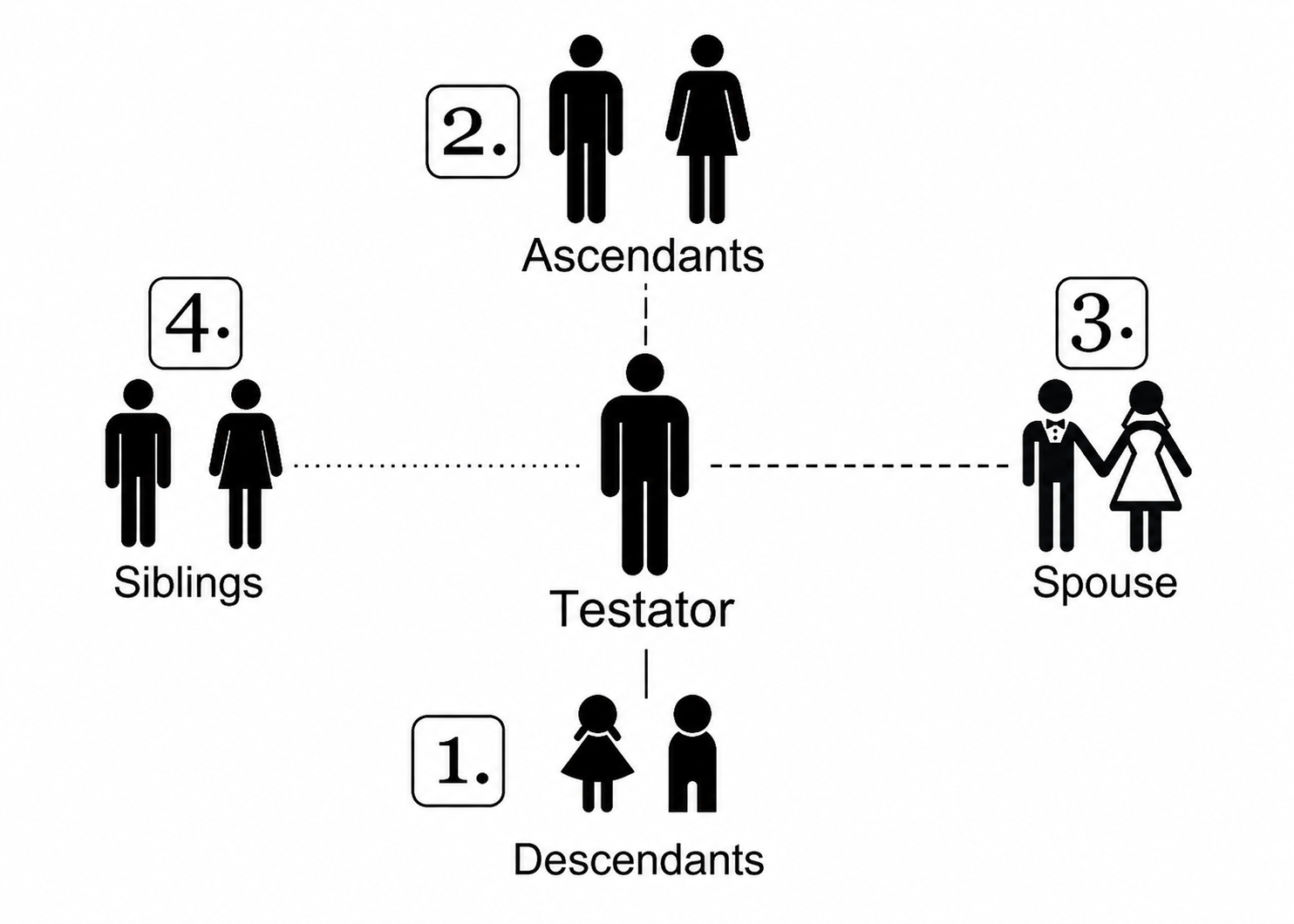
If the deceased has descendants, they inherit before all others and therefore exclude the deceased's ascendants from entitlement to a compulsory share (1). If the deceased has no descendants, neither children nor grandchildren, the ascendants inherit (2).
If the deceased has neither descendants nor living ascendants, the estate passes to the spouse (3). If the deceased was not married, the estate passes to the deceased's siblings and their descendants (nephews and nieces) (4). If none of these relatives can be found, the State ultimately inherits or, where regional civil-law rules (foral law) apply, the relevant Autonomous Community.
Accordingly, the following persons are generally relevant for compulsory-share purposes in both Spain and Germany:
1. The descendants of the deceased
3. The spouse of the deceased
2. The ascendants of the deceased
3. The siblings of the deceased

Amount and allocation of the compulsory share
Persons entitled to a compulsory share may claim it if they are excluded from statutory succession by the will. The same applies if a person entitled to a compulsory share is appointed as an heir under the will but receives less than the statutory compulsory share. In Germany, the compulsory share generally amounts to 50% of the statutory share of the estate, whereas under Spanish law it may amount to up to one third of the estate.
If the share allocated to a person entitled to a compulsory share is burdened by legacies or conditions, that person may, subject to the applicable rules, disclaim the restricted or encumbered share or any subsequent inheritance allocated to them within the relevant disclaimer period and claim the full compulsory share. As explained in the previous section, a person entitled to a compulsory share who has been granted a legacy may disclaim the legacy and claim the full compulsory share. If the legacy is accepted, its value is credited against the compulsory share.
The compulsory-share claim is calculated on the basis of the value of the estate at the time of death. As the deceased's descendants and spouse are the first persons relevant to compulsory-share rights in Germany, the amount and allocation of the compulsory share among the descendants must first be considered. If the deceased was married, the spouse's rights must also be calculated. In Spain, when the spouse concurs with descendants, the spouse is not entitled to an ownership share on this basis but has a right of usufruct over part of the estate.
A) Descendants
a) Spain
In Spain, two thirds of the estate are generally reserved for descendants. One of these two thirds must in all cases be distributed among the descendants in accordance with the rules governing the legítima estricta, while the second third may be used to improve (mejora ) the shares of individual descendants. If the deceased has several descendants, they are in any event entitled to the share prescribed by law in the third known as the “legítima estricta”. With regard to the third reserved for improvement, the "mejora", the deceased may distribute it among the descendants within the limits laid down by law. The deceased is free to use this third or not. If it is not used, it remains within the reserved portion and passes to the heirs in accordance with the general rules.
One particular feature of the mejora is that the deceased may entrust the spouse with the decision on how it is to be distributed. If the spouse is not expressly authorised to make that decision in his or her own will and no time limit has been specified, the decision must be made within two years. An example can be found on page 79.
The improvement may consist either of a specific asset or of a larger share of the estate. It is therefore possible to allocate a specific asset to one of the descendants provided that its value does not exceed the improvement third together with that descendant's share of the strict compulsory portion (legítima estricta). Examples can be found in the book: "Wills and Inheritance Law for Germans in Spain".
The deceased may freely dispose of the final third of the estate (libre disposición) and may leave it to an heir, the spouse or any other person, including a third party. As regards the descendants as a group, the deceased therefore has complete freedom of disposition over one third of the estate. As regards individual descendants, the possibility of favouring one or more of them may extend to as much as two thirds of the estate by using the mejora.
The estate is divided into three parts:
|
Strict compulsory portion (legítima estricta) |
Improvement (mejora) |
Freely disposable portion (libre disposición) |
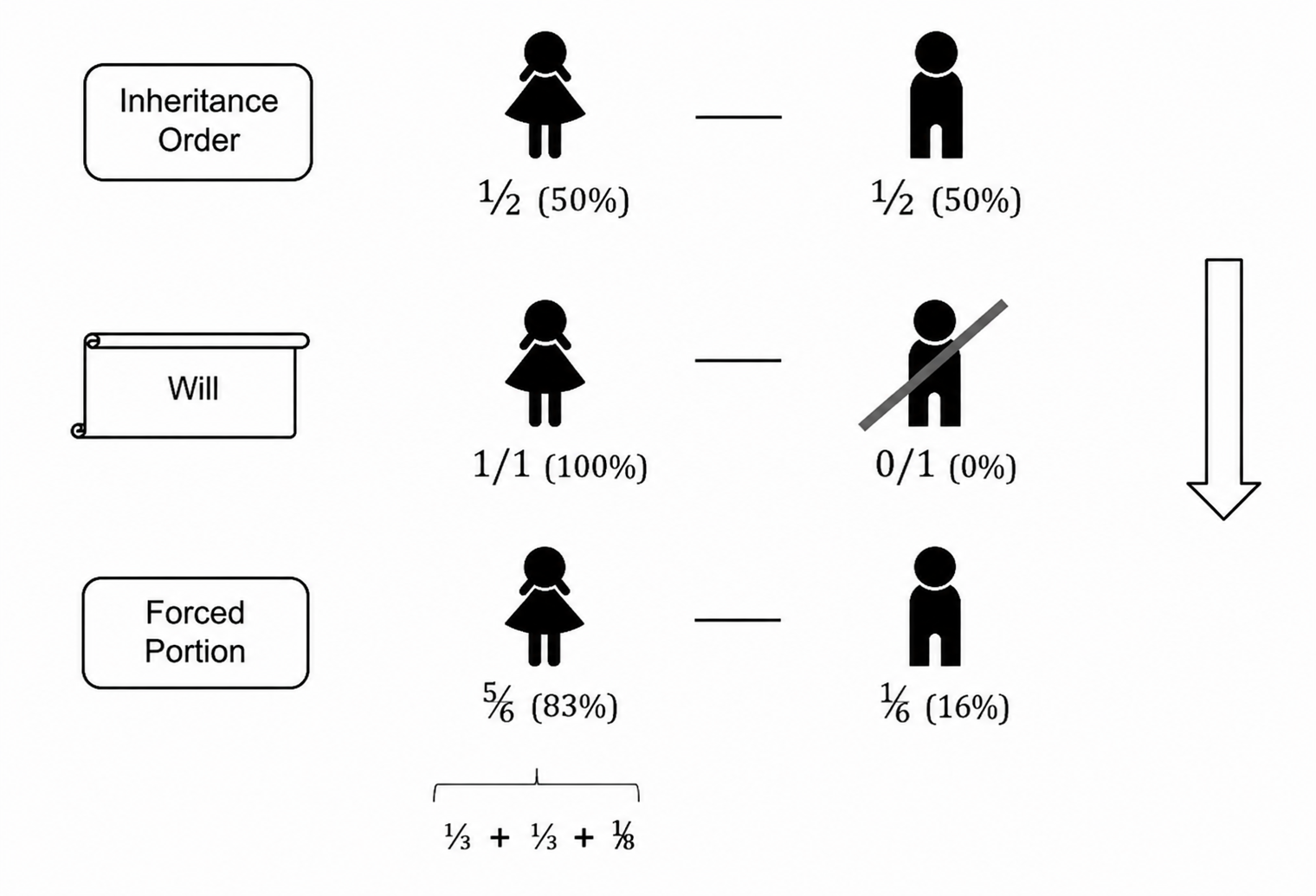
Example: Antonio dies as a widower and has two children, Lisa and Juan. He wishes to leave his entire estate to his daughter Lisa and reduce Juan's inheritance as far as legally possible. As regards Juan, Antonio must respect Juan's legítima estricta, which in this case consists of one half of the first third. Antonio may allocate both the freely disposable third and the improvement third (mejora) to Lisa, so that Juan receives only his share of the strict compulsory portion.
b) Germany:
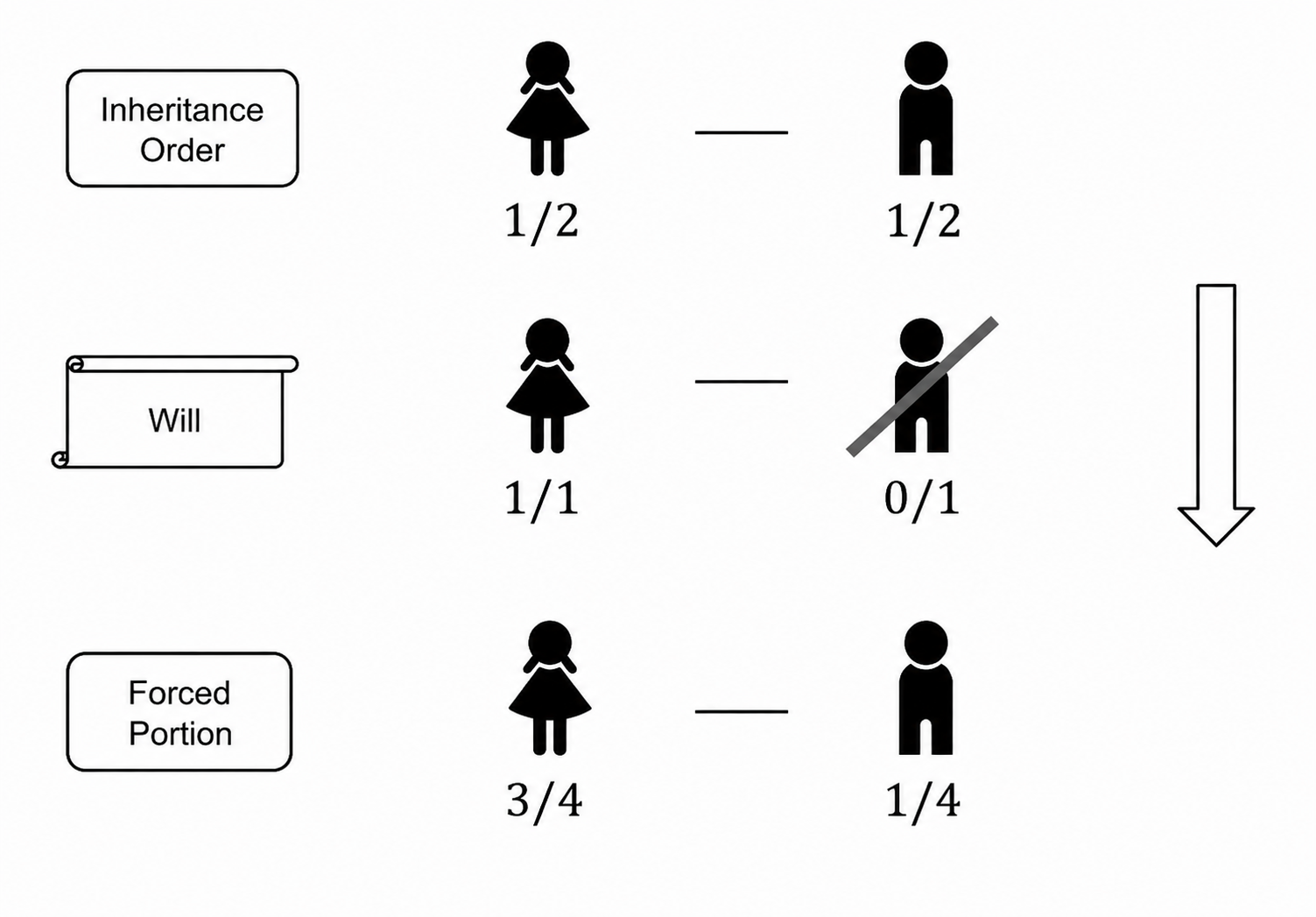
In contrast to the calculation of the Spanish compulsory share, the German compulsory share is considerably easier to calculate, as it generally amounts to one half of the statutory share of the estate.
Example: Antonio dies as a widower and has two children, Lisa and Juan. He wishes to leave his entire estate to his daughter Lisa and reduce Juan's inheritance as far as legally possible. Under the rules of statutory succession, Juan would have been entitled to one half of the estate. His German compulsory share is therefore one half of that statutory share, i.e. ¼ of the estate. Antonio may consequently leave ¾ of the estate to his daughter, while Juan receives only his compulsory share.
B) Spouse
a) Spain
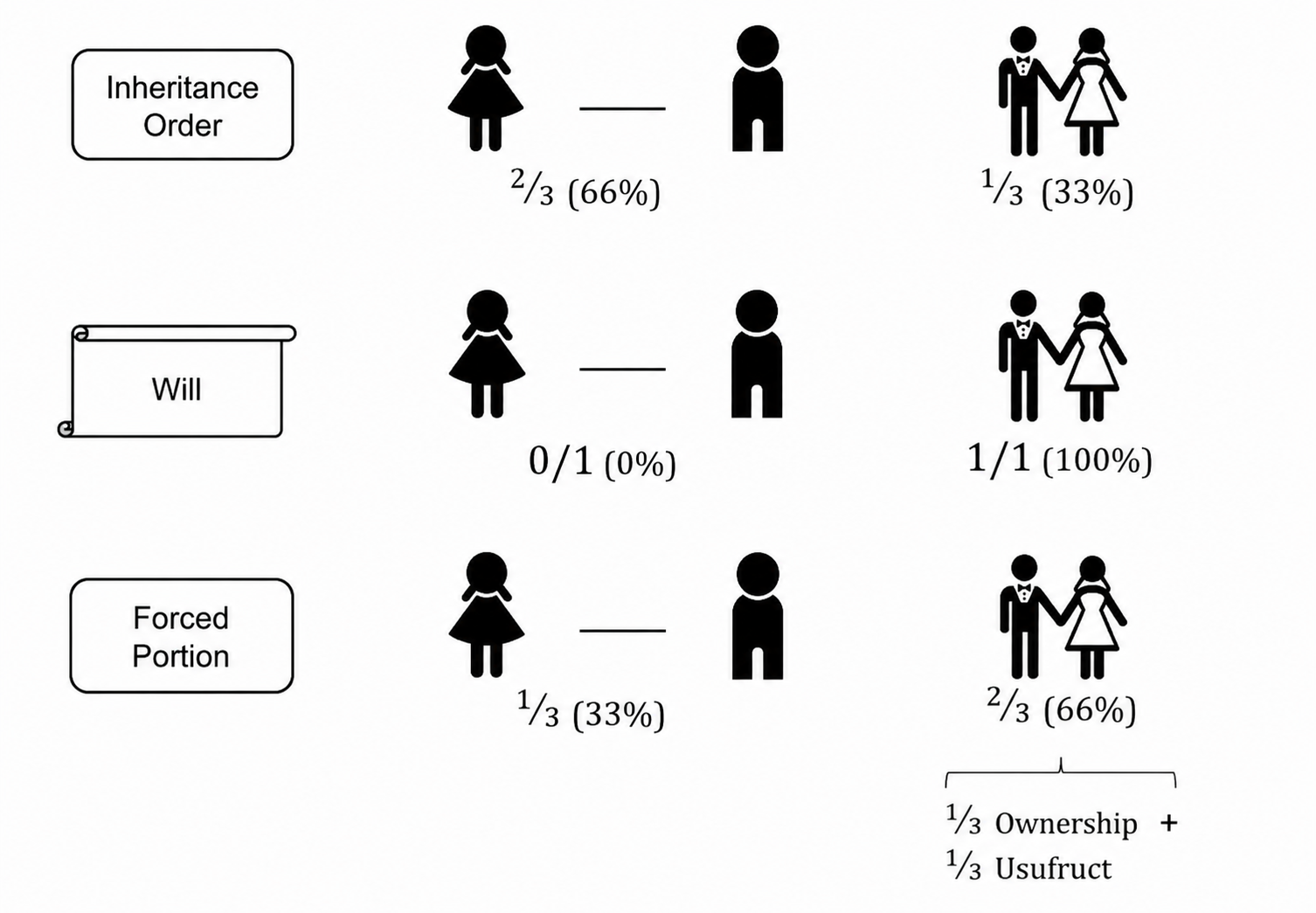
As mentioned in the preceding sections, under Spanish law the spouse is, in this situation, entitled to a usufruct over part of the estate and is not necessarily an heir in ownership. The relationship between statutory succession and compulsory-share rights differs under German and Spanish law. In Spain, persons entitled to the reserved share are referred to as legitimarios. This group also includes the spouse, who, when concurring with descendants, is entitled to the usufruct of the improvement third.
|
Strict compulsory portion (legítima estricta) |
Improvement (mejora) |
Freely disposable portion (libre disposición) |
If the deceased wishes to leave the spouse with the greatest possible interest in the estate, the spouse may be appointed heir to the freely disposable third while also retaining the usufruct over the improvement third. As this usufruct forms part of the spouse's statutory reserved rights (legítima), it applies even if the spouse is only granted the freely disposable third or is not mentioned in the will at all.
b) Germany
In Germany, the spouse's inheritance rights generally depend on the matrimonial property regime. In the usual case, where no marriage contract has been concluded, the spouses are subject to the German community of accrued gains regime (Zugewinngemeinschaft), which may increase the spouse's statutory share. Under this regime, the statutory share of the surviving spouse is increased by one quarter.
Unlike under Spanish law, under German law a person entitled to a compulsory share who is excluded by will does not become the legal successor of the deceased or a member of the community of heirs. Instead, that person has a monetary claim against the heirs for payment of the compulsory share.

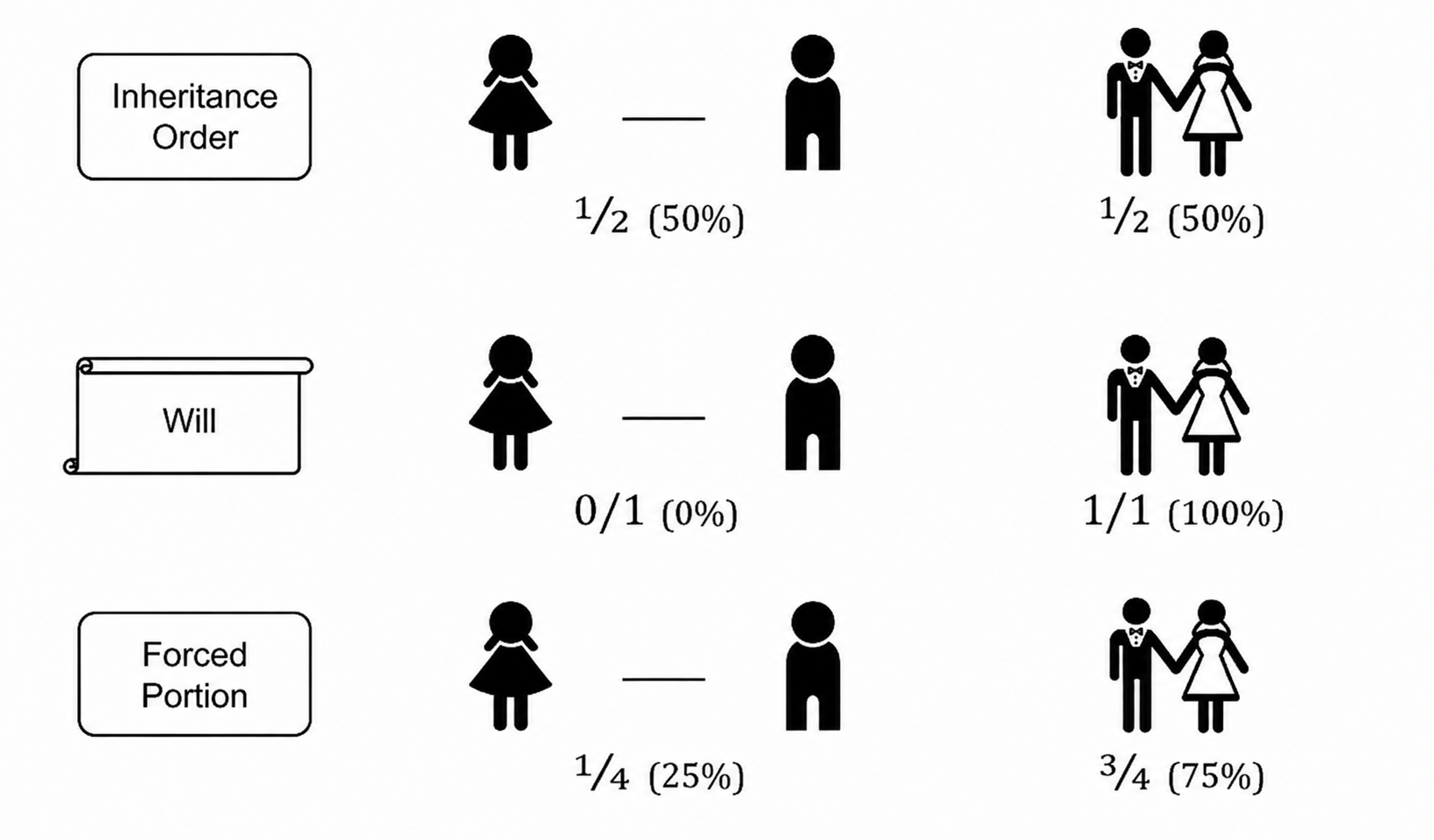
Example: Antonio dies married and without a marriage contract. He has two children, Lisa and Juan, and wishes to leave his entire estate solely to his wife. He therefore appoints his wife as sole heir in his will and excludes his children. The children's statutory share would amount to one half of the estate, since the wife is entitled to the other half through her own statutory share (¼) plus the increase resulting from the matrimonial property regime (¼). If the deceased excludes the children by will, they are entitled only to one half of their statutory share (¼). Antonio can therefore leave 75% of the estate to his wife.
C) Supplementary compulsory-share claims and the treatment of gifts
a) Spain
In Spain, whether a lifetime gift made by the deceased must be taken into account depends on the recipient of the gift and on whether it exceeds the freely disposable part of the estate. Where a gift is made to third parties, i.e. persons who are not forced heirs, it may not prejudice the reserved rights of the forced heirs. If the gift infringes those rights, the forced heirs may seek the appropriate reduction of the gift.
If, during his or her lifetime, the deceased makes a gift to a descendant or person entitled to a reserved share (legitimario), the deceased may specify that the gift is to constitute an improvement (mejora). In that case, the gift is allocated in accordance with the rules governing the improvement, provided that it does not exceed the applicable statutory limits. If it exceeds the improvement third, or if it was not expressly made as an improvement, its allocation to the compulsory share and, where appropriate, to the freely disposable portion must be considered.
b) Germany
To prevent the deceased from circumventing compulsory-share rights by giving away assets during his or her lifetime, German inheritance law provides, in certain circumstances, for a supplementary compulsory-share claim. For this purpose, gifts may be taken into account in the calculation as though all or part of the gifted property were still included in the estate. Unlike under Spanish law, this supplementary claim is subject to time limits. Older gifts are taken into account to a lesser extent than gifts made shortly before death.
If a gift was made within one year before the death, it is taken into account at 100% for these purposes. The following table shows the percentage at which gifts are taken into account depending on the number of years that have elapsed.
|
in the 1st year before death |
100% |
|
in the 2nd year before death |
90% |
|
in the 3rd year before death |
80% |
|
in the 4th year before death |
70% |
|
in the 5th year before death |
60% |
|
in the 6th year before death |
50% |
|
in the 7th year before death |
40% |
|
in the 8th year before death |
30% |
|
in the 9th year before death |
20% |
|
in the 10th year before death |
10% |
|
in the 11th year before death |
0% |
Gifts received by the person entitled to the compulsory share from the deceased must likewise be taken into account when calculating any supplementary compulsory-share claim. A beneficiary must credit against his or her own compulsory share anything received from the deceased during the deceased's lifetime where it was expressly stipulated that the gift was to be credited against that compulsory share.
Summary and conclusion
Spanish inheritance law is largely based on blood relationship and therefore generally gives descendants a stronger position than the spouse. Two thirds (⅔) of the estate are reserved for forced heirs and, in the first instance, for the descendants of the deceased. However, this preferential position applies to the descendants as a group, since the deceased may use the mejora to favour one or more descendants over the others. If, for example, a widowed deceased leaves two descendants, it is possible to leave one of them up to five sixths of the estate, whereas under German law the proportion referred to in this example is limited to three quarters (75%).
A further difference is that, under Spanish inheritance law, a forced heir (heredero forzoso / legitimario) does not merely have a monetary claim against the appointed heir; the legal position of the forced heir may also have a direct impact on the partition of the estate.
Under German inheritance law, by contrast, the position of the surviving spouse is stronger. In the situation described, and in the absence of a marriage contract, the spouse may be entitled to one half of the estate under statutory succession, while the descendants' compulsory share may be reduced to one quarter (¼) of the estate. As illustrated in the diagrams above, the deceased may therefore leave up to three quarters (75%) of the estate to the spouse.
In Spain, by contrast, the two thirds of the estate reserved for children and other descendants must generally be respected, meaning that the freely disposable third (⅓) may be left to the spouse. If the spouse's statutory usufruct is also taken into account, the spouse may enjoy a larger part of the estate for life, although only part of it passes into the spouse's ownership.
Our law firm will be pleased to analyse your individual situation, carry out the necessary administrative procedures on your behalf and assist you with the filing of the relevant tax returns. If you would like further information or have specific questions on this subject, please feel free to contact us by email or telephone.
Autor:

Christoph Sander
Lawyer and Tax Advisor
CEO, Partner, Director
info@sspartners.es
Tel: (+34) 951 12 13 06
Facebook I LinkedIn I Amazon
Stay informed! Follow us on:


 (+34)
(+34)