


Particularly in cross-border e-commerce using the OSS (One-Stop Shop) scheme from Spain, businesses are often required to finance VAT for up to one year. This is because VAT must be paid separately in each country of consumption, while input VAT can generally only be reclaimed after filing the final VAT return in January of the following year. Further information about the OSS system can be found in our article: E-Commerce and the OSS (One-Stop Shop) Scheme.
REDEME and SII – Monthly VAT Refunds
REDEME is a special VAT regime that allows businesses to claim VAT refunds on a monthly basis instead of waiting until the end of the year or January of the following year under the standard VAT system. Registration for REDEME is made by filing Form 036 and automatically entails participation in the SII system, which is explained below.
Advantages:
- Improved liquidity and cash flow: If your business pays more VAT than it can offset (for example due to investments, purchases, imports, renovations or exports), REDEME allows you to recover this VAT every month instead of waiting until the end of the financial year.
- Better financial planning: Monthly VAT refunds provide greater certainty when planning investments and operating expenses.
- Avoid financing costs and lengthy VAT refund periods: Particularly beneficial for businesses making significant investments or purchases during the year that do not wish to finance VAT on behalf of the Spanish Tax Agency for several months.
- Simplified tax and accounting obligations: Companies registered under both SII and REDEME are exempt from filing several additional VAT reporting forms, including Forms 340, 347 and 390.
- In most cases, businesses operating under the SII system are not required to implement the mandatory Veri*Factu system, which will become compulsory from 2027 onwards.
- Greater legal certainty and tax control: As invoices are electronically recorded through SII, businesses maintain reconciled accounting records that facilitate tax audits and reduce discrepancies with suppliers and customers.
Possible disadvantages:
- Higher administrative workload and compliance costs: Instead of filing quarterly VAT returns, businesses must submit twelve VAT returns per year, resulting in increased monthly accounting work.
- Mandatory electronic VAT ledgers through SII: Invoice information must be submitted within very short deadlines, generally within 4 to 8 calendar days after the invoice has been issued or received.
- Need for compatible accounting software and adequate internal resources: To comply with the Immediate Supply of Information (SII) requirements, businesses may need to invest in suitable accounting and invoicing software as well as properly trained staff. Our firm provides all the necessary software and technical tools to process invoices on a weekly basis, submit accounting records electronically to the Spanish Tax Agency (AEAT) and apply for monthly VAT refunds.

Suitable Business Profile
For e-commerce businesses, this system is particularly advantageous where products are mainly sold in countries other than the country of import or purchase. This is typically the case where sales are made through the One-Stop Shop (OSS) scheme or under local VAT registrations. In these situations, input VAT on purchases or imports can be deducted, but it cannot be directly offset against the VAT payable on sales, as this VAT is declared and paid in another Member State.
Cost-Benefit Analysis
For example, if goods are imported from China into Spain and subsequently sold exclusively within Spain, the import VAT can be offset against the output VAT payable, resulting in a neutral VAT position in the quarterly VAT return.
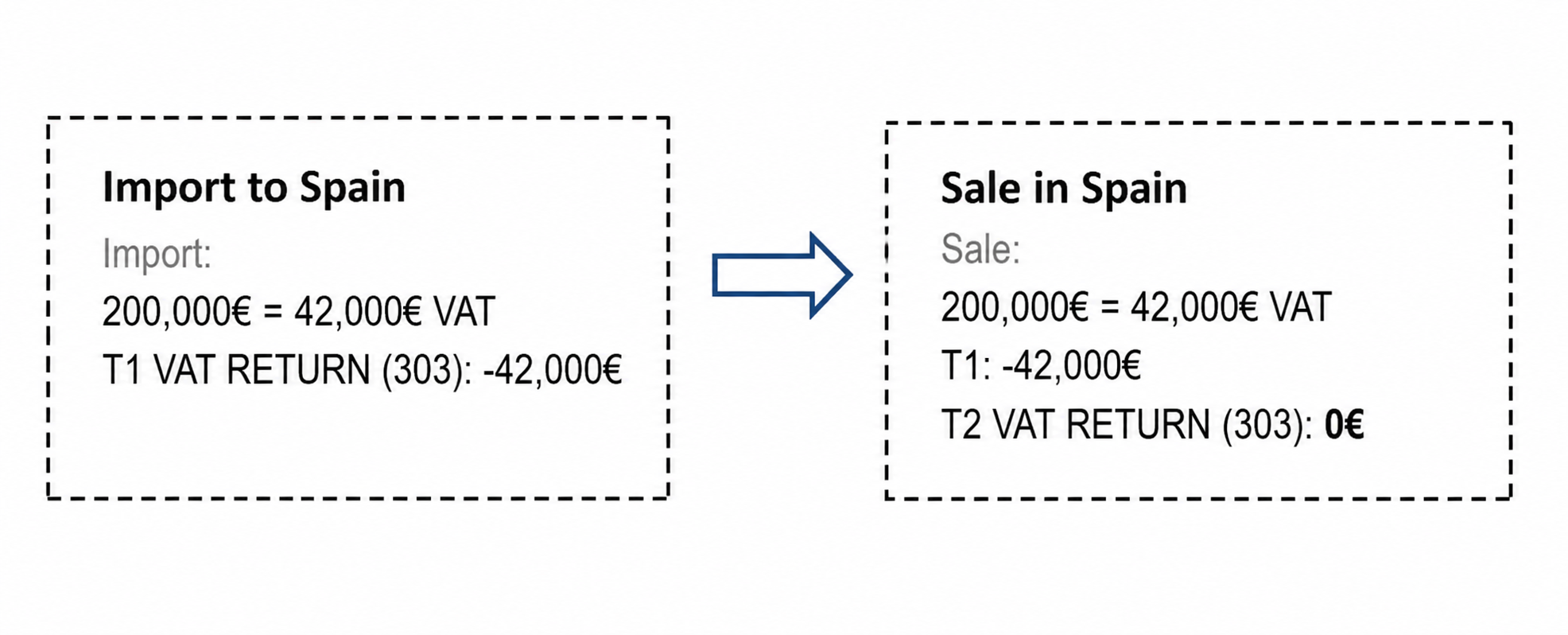
However, if those goods are sold throughout the European Union under the OSS scheme, VAT is paid in each Member State of destination and can no longer be offset against the import VAT paid in Spain through Form 303.
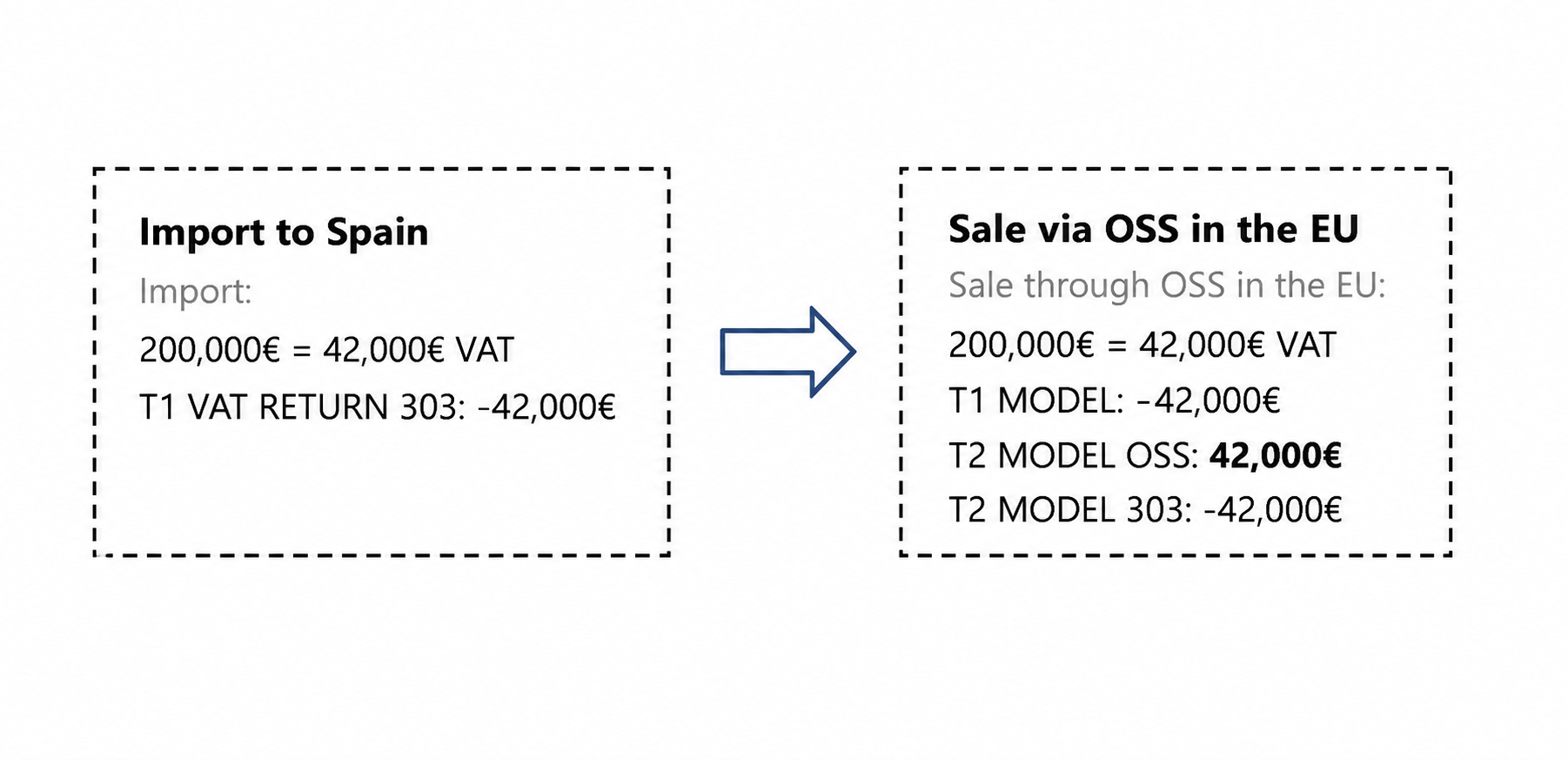
In the second quarter, the positive VAT amounts declared through the OSS must be paid, while Form 303 in Spain still shows a negative VAT balance. Without monthly VAT refunds under REDEME, this VAT credit would have to be carried forward from one quarter to the next until it can finally be reclaimed after the fourth quarter, usually in January of the following year.
Assuming quarterly sales of €200,000, imports into Spain and subsequent sales throughout the European Union under the OSS scheme, the estimated financing costs of pre-financing the VAT until reimbursement—based on an assumed financing rate of 10%—would amount to approximately €10,500:
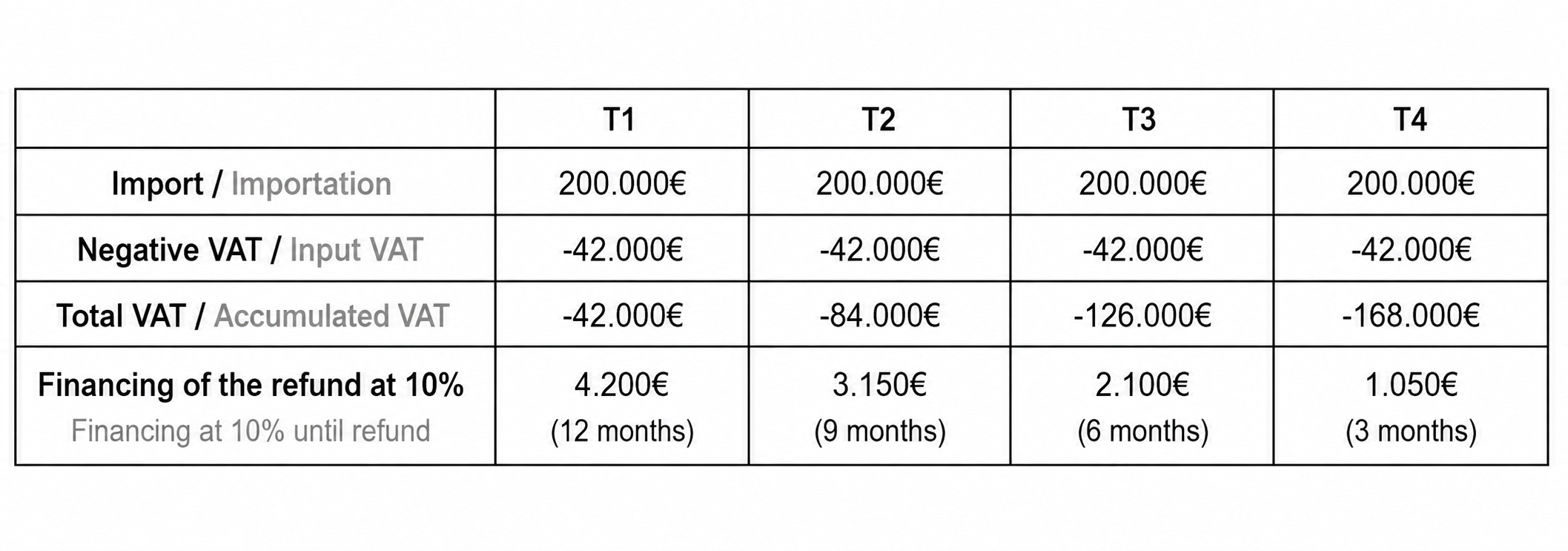
By comparison, the administrative costs for REDEME and SII under this service package would amount to approximately €1,920. Consequently, using the system could generate estimated savings of around €8,130 by significantly reducing financing costs.

How the System Works and Tax Compliance Obligations
- Registration for REDEME automatically requires participation in the SII system. This includes maintaining the electronic VAT ledgers and submitting accounting records to the Spanish Tax Agency (Agencia Tributaria – AEAT). As an additional advantage, businesses registered under SII are generally exempt from the future mandatory invoice reporting system Veri*Factu, which will apply from the 2027 tax year.
- Invoice submission deadlines:
- Invoices issued by third parties (e.g. Amazon): every seven days or once a week, depending on the agreed bookkeeping schedule.
- Purchase invoices: since these must be reported within four calendar days after being entered into the accounting records (with an absolute deadline of the 16th day of the following month), we recommend sending us all supplier invoices once per month.
- If the company operates a warehouse or distribution centre in another country and goods are dispatched from that location, it is generally required to obtain a local VAT number and submit VAT returns in that country. These filings must normally be handled by a local tax representative. While we include these transactions for Spanish Corporate Income Tax purposes, we do not prepare VAT returns that must be filed outside the OSS system.
- For accounting purposes, all sales invoices are initially recorded as paid. In the case of Amazon and similar marketplaces, sales are treated as settled upon invoicing, as no receivables remain outstanding from the final customer. The recorded amounts are subsequently reconciled with the actual payments received in the company's bank account.
- Maintaining inventory records is a legal requirement. This includes an opening inventory and a closing inventory at the end of each financial year. In addition, we require an inventory report at the end of every quarter to ensure that the profit and loss account accurately reflects the company's financial position. We recommend using the inventory management system provided by the sales platform (e.g. Amazon) or another automated inventory solution.
- Please note that the OSS scheme applies exclusively to sales made to private consumers (B2C). Sales to businesses holding a valid VAT identification number (B2B) must be recorded separately and reported using Form 349 on either a monthly or quarterly basis.
Our law firm and tax advisory practice will be pleased to analyse your specific business structure, carry out the necessary administrative procedures and prepare the required tax filings on your behalf. If you have any questions or require further advice, please do not hesitate to contact us by email or telephone.
Corporate Service Agreements:
Book an Initial Consultation (A, B2)


Accounting Services for E-Commerce Companies
Author:

Bernardo López
Tax advisor
info@sspartners.es
Tel: (+34) 951 12 13 06
Facebook I LinkedIn I Amazon
Stay informed! Follow us on:


 (+34)
(+34)