



The purchase and sale of real estate in Spain involves a number of tax obligations for both the buyer and the seller. Understanding these taxes is essential not only to ensure compliance with the applicable legal requirements, but also to optimise the costs associated with the transaction.

Below, we outline the main taxes that both parties should take into account in accordance with the Spanish General Tax Law (Ley General Tributaria) and the regulations applicable for 2025.
1. Which taxes are payable directly when purchasing a property?
The taxes payable when purchasing a property generally depend on whether the property is residential or commercial and, in the case of residential property, whether it is a new-build or a second-hand property.
a) Purchase of a second-hand property: Property Transfer Tax (Impuesto sobre Transmisiones Patrimoniales, ITP):
• What is ITP? This is a tax payable on the purchase of second-hand properties. The tax rate varies depending on the Autonomous Community and generally ranges from 6% to 11% of the purchase price.
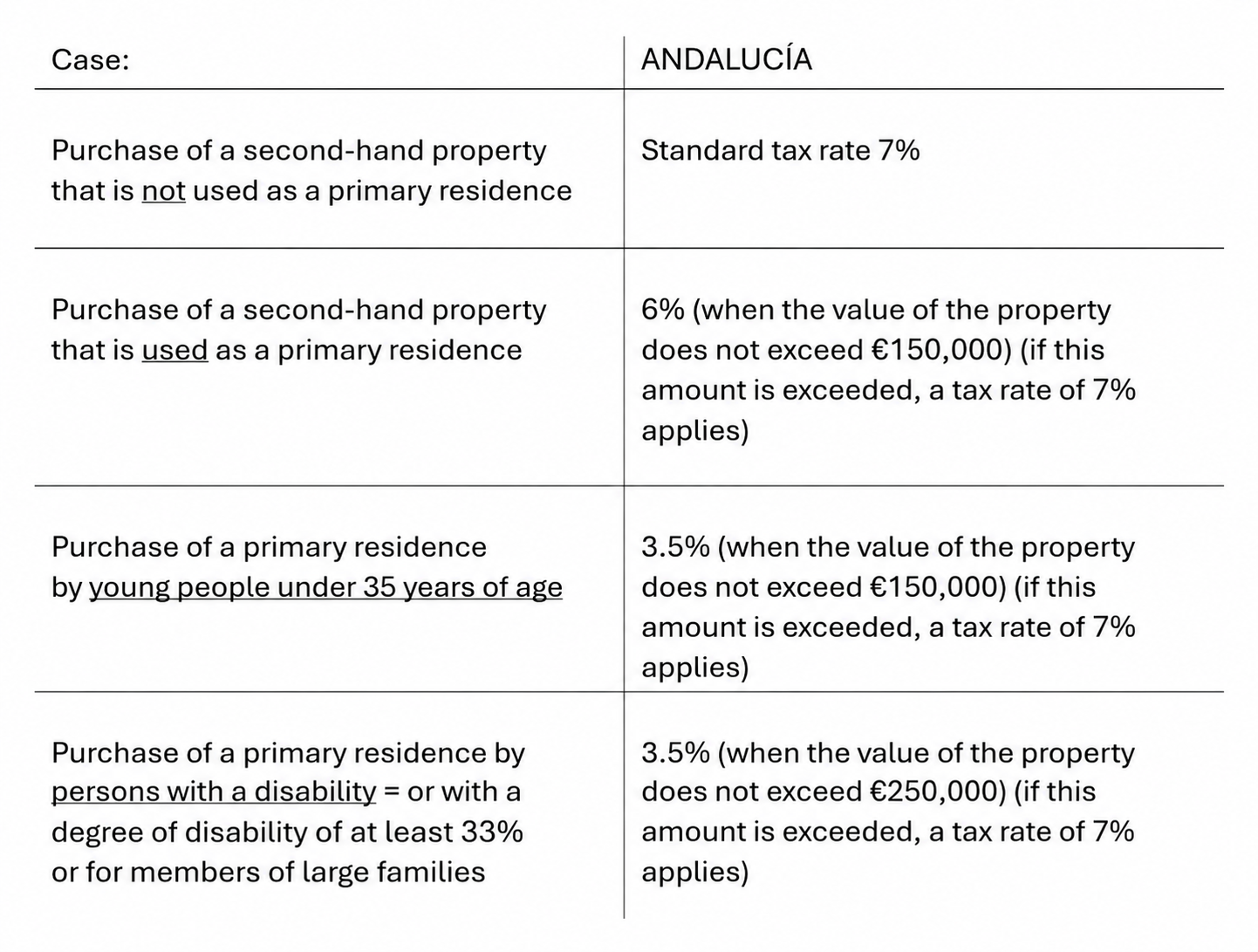
Example: A 32-year-old purchases a primary residence in Málaga for €180,000.
Calculation:
As the purchase price of the property exceeds €150,000, the reduced tax rate does not apply.
€180,000 x 7% = €12,600
The ITP payable amounts to €12,600.
Filing deadline: ITP must be paid within 30 working days from the date on which the purchase deed is signed.

b) Purchase of a new-build residential property or commercial premises: Value Added Tax (IVA) and Stamp Duty (AJD):
• What is IVA? This is a tax payable on the purchase of a new-build property. In this case, the seller must add Value Added Tax (IVA) to the purchase price. As many properties are advertised as “price plus IVA”, the applicable tax rates should be taken into account:
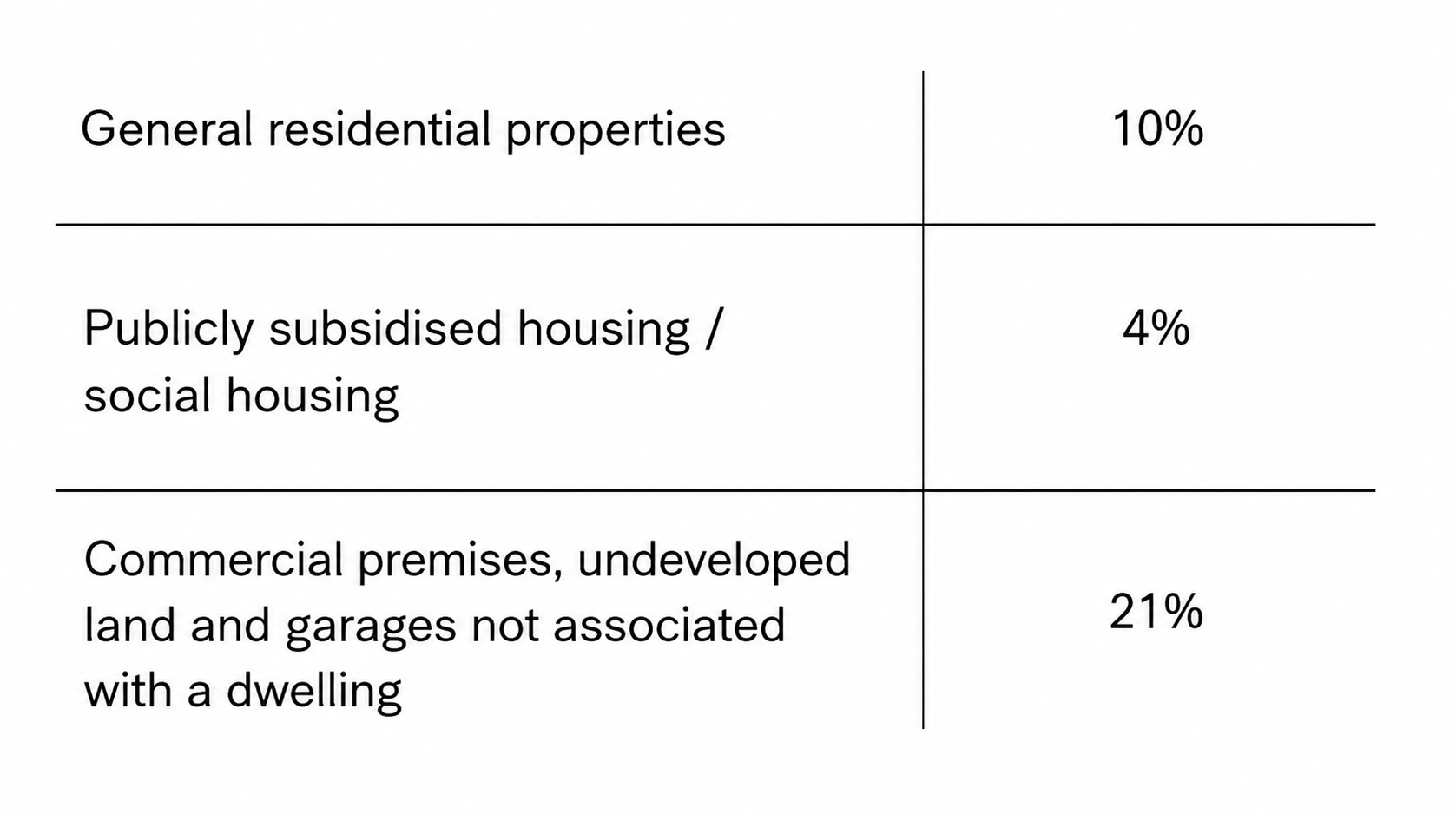
Example: A 32-year-old purchases a new-build primary residence in Málaga for €200,000.
Calculation:
Purchase price = €200,000
IVA (10%) = €20,000
Total price including IVA = €220,000
Payment deadline: As IVA is collected by the seller, the buyer will normally pay the tax together with the purchase price when the transaction is completed before the notary. As purchases subject to IVA are exempt from ITP, Stamp Duty (Actos Jurídicos Documentados – AJD) is payable instead and is borne by the buyer.
• Stamp Duty (Actos Jurídicos Documentados – AJD): This tax is levied on the execution of certain documents in notarised form, for example in connection with new-build residential properties or commercial premises. The applicable rate generally ranges between 0.5% and 1.5% of the property value.
Filing deadline: As with ITP, AJD must be paid within 30 working days after signing the deed. The tax return is filed using Form 600 (Modelo 600) with the competent tax authority of the relevant Autonomous Community.
• When purchasing commercial premises, it should be noted that, under certain circumstances, the reverse charge mechanism for VAT (Inversión del sujeto pasivo) may apply. However, this is only possible if the property was previously used for an economic activity and the buyer also intends to use it for an activity that is subject to and not exempt from VAT. In such cases in particular, it is essential to carefully assess the individual circumstances before completing the purchase, as this special tax treatment must be expressly stated in the notarised purchase deed. It can no longer be applied after the deed has been signed.
2) Other taxes associated with the purchase of property
a) Property Tax – Impuesto sobre Bienes Inmuebles (IBI):
• Description: Although this tax is not payable directly upon purchasing the property, the new owner should be aware of this annual property tax. It is calculated on the basis of the cadastral value, irrespective of whether the property is a new-build or a second-hand property. The amount varies depending on the municipality. The purchase agreement frequently provides for the tax for the current year to be apportioned between the parties: the seller pays the proportion corresponding to the period up to the date of sale, and the buyer pays the proportion from the date on which ownership is transferred. In purchases from non-resident sellers, it is advisable to retain the relevant tax amount from the purchase price, as the buyer may be held liable for its payment in such cases.
• Payment deadline: The payment period is determined individually by each municipality. Municipalities generally issue an annual payment notice. However, property owners remain responsible for ensuring that the tax is paid on time even if no payment notice is received.
To avoid delays, it is advisable to arrange payment by direct debit, which in many municipalities may also entitle the taxpayer to a discount of up to 5% on the tax payable.
b) Personal Income Tax (IRPF) or Non-Resident Income Tax:
• Description: The sale of a property by an individual may give rise to a taxable capital gain, which is subject either to Spanish Personal Income Tax (IRPF) for Spanish tax residents or to Non-Resident Income Tax (IRNR) for non-residents. The gain is calculated as the difference between the sale price and the acquisition price, taking into account deductible expenses (e.g. notary fees, Land Registry fees, taxes, etc.). Thus, if a property is purchased for €150,000 and subsequently sold for €250,000, the resulting capital gain is €100,000. Progressive tax rates are applied to this gain to determine the amount of Personal Income Tax (IRPF) payable. In addition, tax may also arise from the mere ownership of property in Spain. For any property that is not used as the owner's primary residence, an imputed property income must be declared. Non-residents comply with this obligation by filing Form 210 (Modelo 210) annually.
• Tax rate: Capital gains are taxed as savings income at progressive rates ranging from 19% to 26%, depending on the amount of the gain. For the year 2024, gains of up to €6,000 are taxed at 19%, while gains exceeding €200,000 are taxed at 26%.
• Expenses that may reduce the taxable capital gain:
1. Expenses that may be added to the acquisition price:
Expenses that may be added to the original acquisition value, thereby reducing the taxable gain, include notary fees, administrative and management fees, Land Registry fees and Property Transfer Tax paid when acquiring a second-hand property. In the case of a new-build property, Value Added Tax (IVA) and Stamp Duty (AJD) are also relevant. Investments and improvements made to the property may likewise be included in the calculation, such as measures to improve energy efficiency, replacement of electricity, water, gas or heating installations, and the installation of telecommunications infrastructure providing access to internet or digital television services.
2. Expenses deductible from the sale price:
Certain expenses associated with the sale may also be taken into account. These include, in particular, notary fees, administrative and management fees, Land Registry fees, costs relating to the cancellation of existing charges or mortgages, taxes associated with the sale and any estate agent's commission.
• Exemptions: It is important to note that Spanish law provides for certain exemptions under which taxpayers may be exempt from Personal Income Tax (IRPF) on capital gains arising from the sale of a property.
The three main exemptions are:
1. Reinvestment in a primary residence: Where the primary residence is sold and all or part of the proceeds are reinvested in the acquisition of a new primary residence within two years. This exemption does not apply automatically and must be expressly claimed in Form 100 (Modelo 100 – Personal Income Tax Return).
2. Sale of the primary residence by persons over 65 years of age.
3. Sale of the primary residence by persons with severe or high-level care dependency.
• Non-residents: Where the seller is not a Spanish tax resident, the buyer is required to withhold 3% of the sale price. Once this amount has been paid to the Spanish Tax Agency on behalf of the seller, the seller must file Form 210 (Modelo 210), calculating the capital gain in accordance with the criteria outlined above. A fixed tax rate is applied to this gain: 19% for tax residents of the EU and 24% for tax residents of third countries. It is important to emphasise that the seller is responsible for filing this tax return without the need for a prior request from the Spanish Tax Agency.

c) Municipal Tax on the Increase in Land Value (Plusvalía Municipal):
• Description: This tax, officially known as the “Impuesto sobre el Incremento de Valor de los Terrenos de Naturaleza Urbana”, is levied on the increase in the value of the land during the period in which it was owned by the seller. It is a municipal tax and its calculation depends on the relevant local authority.
• Filing deadline: The seller must declare and pay this tax within 30 days after signing the notarised deed (Escritura).
d) Wealth Tax (Impuesto sobre el Patrimonio):
• Description: Although this tax is not payable directly as part of the transaction, the buyer may be required to declare and, where applicable, pay it if their net wealth exceeds the exempt amount established by the relevant Autonomous Community (for Spanish residents) or depending on the value of their assets located in Spain (for non-residents). Wealth Tax is levied on the overall value of the taxpayer's assets. The current exemption generally ranges, depending on the region, from €700,000 to €3.7 million per person.
• Tax rate: The tax rates are progressive and range from 0.2% to 2.5%.
• Filing deadline: The tax return must be filed annually between 1 April and 30 June. The tax is calculated on the basis of the total value of the taxpayer's assets and rights.
Final Remarks
When purchasing or selling a property, it is essential for both buyers and sellers to obtain timely information about their tax obligations and to seek professional advice. Proper tax planning not only ensures compliance with tax regulations, but also enables more efficient financial planning and may help optimise the financial outcome of the transaction.
Our law firm will be pleased to assist you in analysing your individual circumstances, handling the necessary administrative procedures on your behalf and preparing and filing the relevant tax returns. Should you be interested in our services or have any specific questions regarding this matter, please feel free to contact us by email or telephone.
Author:

Cristina Perello
Tax advisor
info@sspartners.es
Tel: (+34) 951 12 13 06
Facebook I LinkedIn I Amazon
Stay informed! Follow us on:


 (+34)
(+34)