

In order to make the best possible use of the new European rules on the choice of law applicable to succession, it is helpful to be familiar with both German and Spanish inheritance law. In this context, the differences regarding the order of succession and persons entitled to a compulsory share are particularly important, as these differences may be relevant when planning a succession according to the testator’s wishes.
Intestate Succession
Intestate succession applies whenever the deceased has not determined the succession by means of a will or has not appointed any heirs. Due to the principle of habitual residence under European succession law, it is entirely possible for the estate of a German national residing in Spain who did not make the corresponding choice of law before his or her death to be governed by Spanish law. In such a case, the Spanish rules of intestate succession will apply.
In general, the provisions of German and Spanish inheritance law in this respect are very similar and, in both cases, are based on the different degrees of kinship with the deceased. Relatives of a closer degree exclude relatives of a more remote degree. One of the most significant differences between Spanish and German inheritance law concerns the provisions relating to the surviving spouse of the deceased, which are explained in greater detail in the following section.
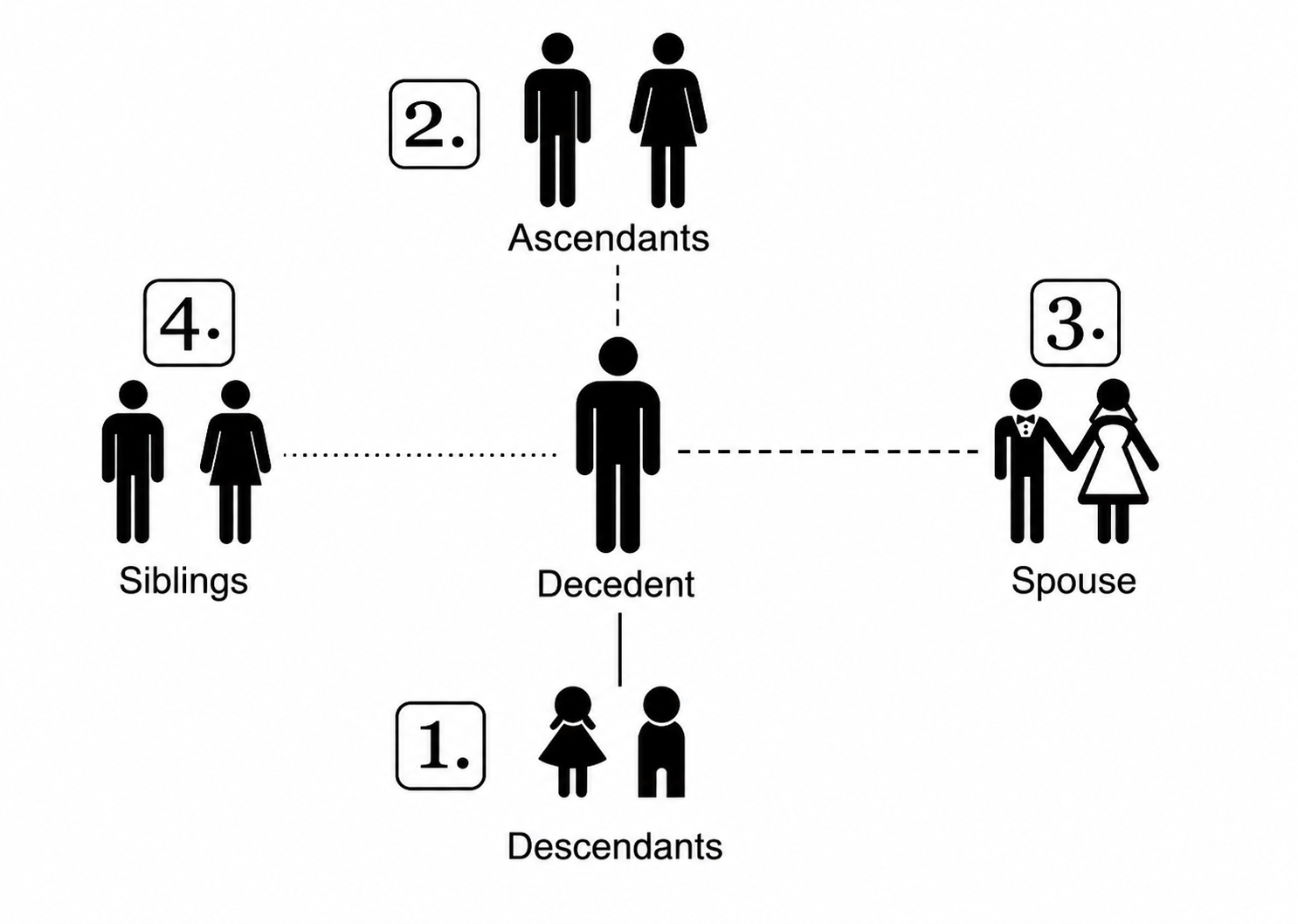
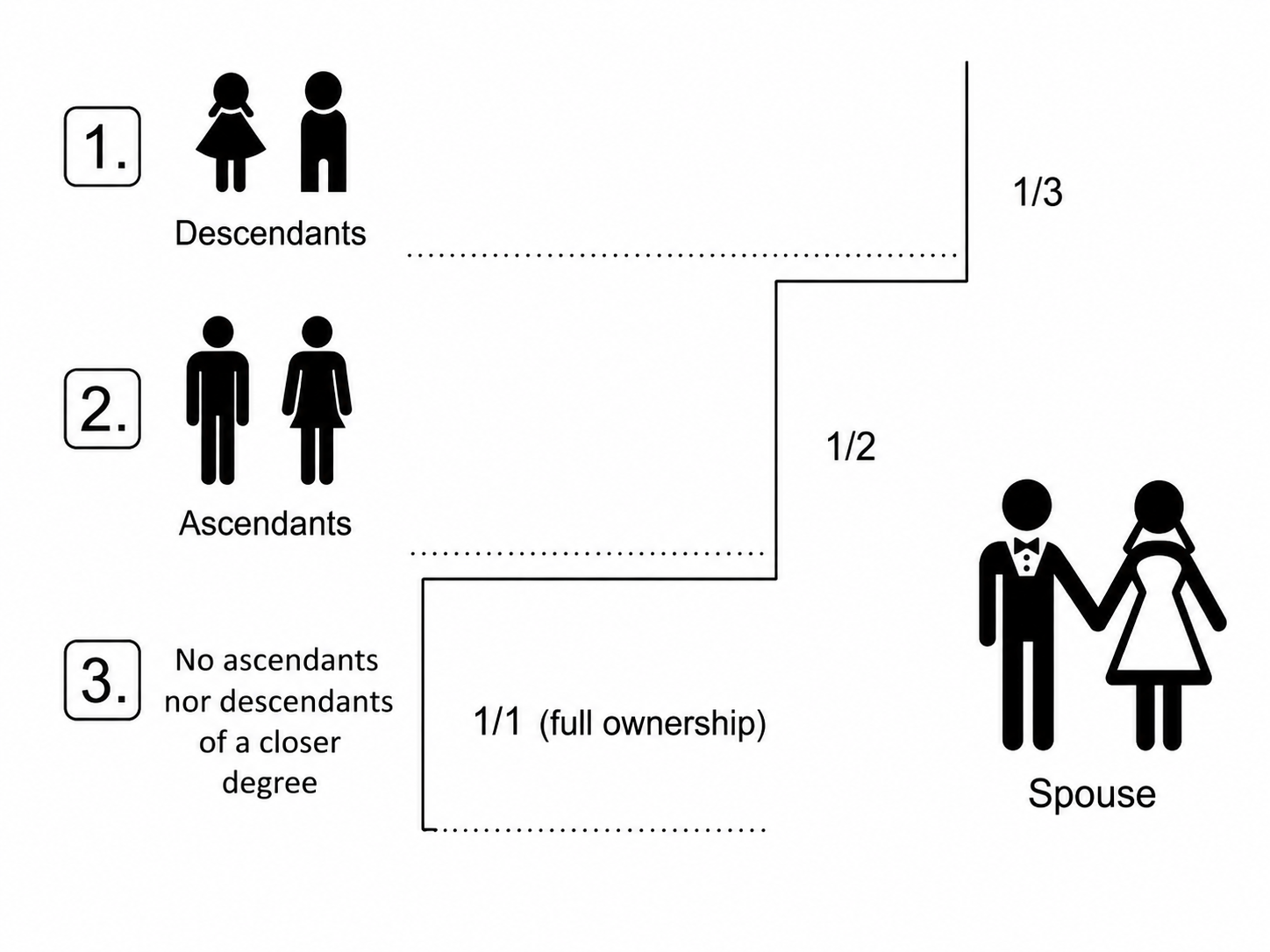
The following diagram first illustrates the order of succession under Spanish law. Descendants inherit first (1). If the deceased has no descendants (neither children nor grandchildren), the ascendants inherit (2). In this case, the surviving spouse is entitled to a usufruct over one half (½) of the estate.
If the deceased has neither descendants nor surviving ascendants, the estate passes to the spouse (3). If the deceased was not married, the estate passes to his or her siblings and their descendants (nephews and nieces) (4). If no such relatives can be found, the State ultimately inherits or, where regional or special civil law applies, the corresponding Autonomous Community.

If the deceased has descendants, they inherit in preference to all other relatives and therefore exclude them from the succession. It should be noted that, even where no will has been made, the surviving spouse is entitled to a usufruct over one third (1/3) of the estate, provided that the spouses were not separated at the time of death. Such separation may be either legal or de facto.
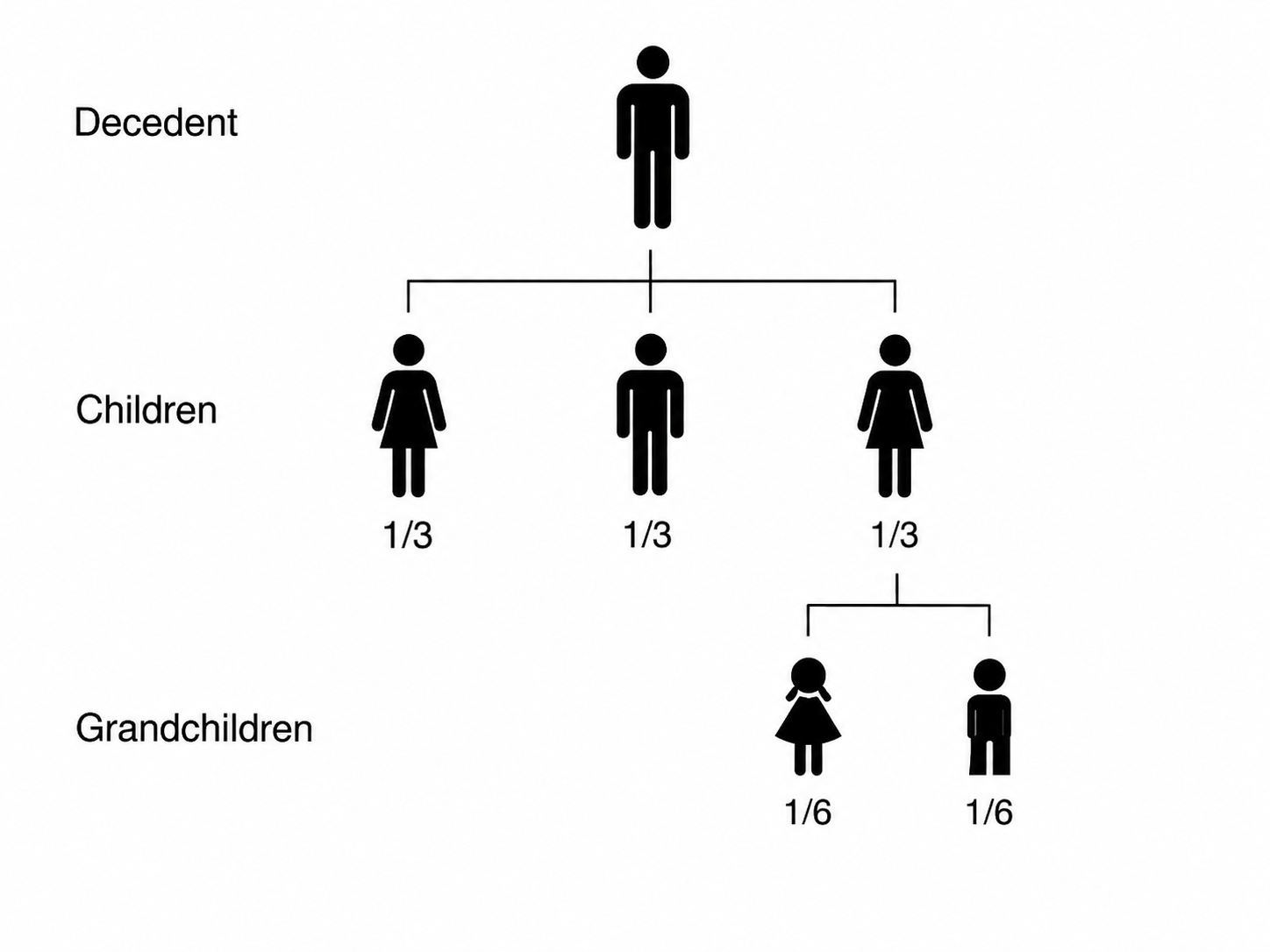
Within the line of descendants, the children of the deceased generally inherit first. Only where a child has already died do that child’s descendants, i.e. the grandchildren of the deceased, take his or her place. If the deceased leaves several children and one of them has predeceased the deceased leaving several descendants, those descendants inherit the share that would have corresponded to the predeceased child by right of representation.
German law has many similarities in this respect, with the principal difference being the direct statutory share of the surviving spouse. Thus, under both legal systems, the descendants, i.e. the children and grandchildren of the deceased, inherit first, and only where a descendant has died do his or her children, i.e. the grandchildren of the deceased, take that descendant’s place (succession by branches). If the deceased has no descendants, his or her parents and their descendants inherit. If both parents are alive at the time the succession opens, they inherit in equal shares. If either the father or the mother has already died, the descendants of the deceased parent take his or her place. If there are no such descendants, the surviving parent inherits alone.
Unlike under Spanish law, under German law the siblings of the deceased rank ahead of the grandparents in the order of succession. The grandparents inherit only if neither the parents of the deceased nor their descendants are alive. The same principle applies to great-grandparents.
Inheritance Rights of the Surviving Spouse:
As mentioned at the beginning of this article, one of the most significant differences between Spanish and German inheritance law concerns the provisions relating to the surviving spouse of the deceased. Under German inheritance law, the spouse is entitled to a direct statutory share of the estate, whereas under Spanish inheritance law the spouse becomes an heir only where there are neither descendants nor ascendants of the deceased. In order to protect the spouse in other circumstances, Spanish law grants the surviving spouse a lifelong usufruct over part of the estate.

Under both German and Spanish inheritance law, the share of the estate or the share granted by way of usufruct depends on which statutory heirs (children, grandchildren, parents or siblings) are called to inherit. Under Spanish law, the surviving spouse is entitled to a usufruct over one third (1/3) of the estate where descendants inherit. If there are no descendants and the ascendants therefore inherit, the spouse is entitled to a usufruct over one half (1/2) of the estate. If neither descendants nor ascendants are alive, the spouse is entitled to the entire estate, which passes into his or her ownership.
Under German law, the surviving spouse of the deceased is entitled, as a statutory heir, to one quarter of the estate when inheriting alongside the descendants, i.e. the children and grandchildren of the deceased, and to one half of the estate when inheriting alongside the parents of the deceased and their descendants. If there are no descendants, ascendants or siblings, the surviving spouse receives the entire estate.
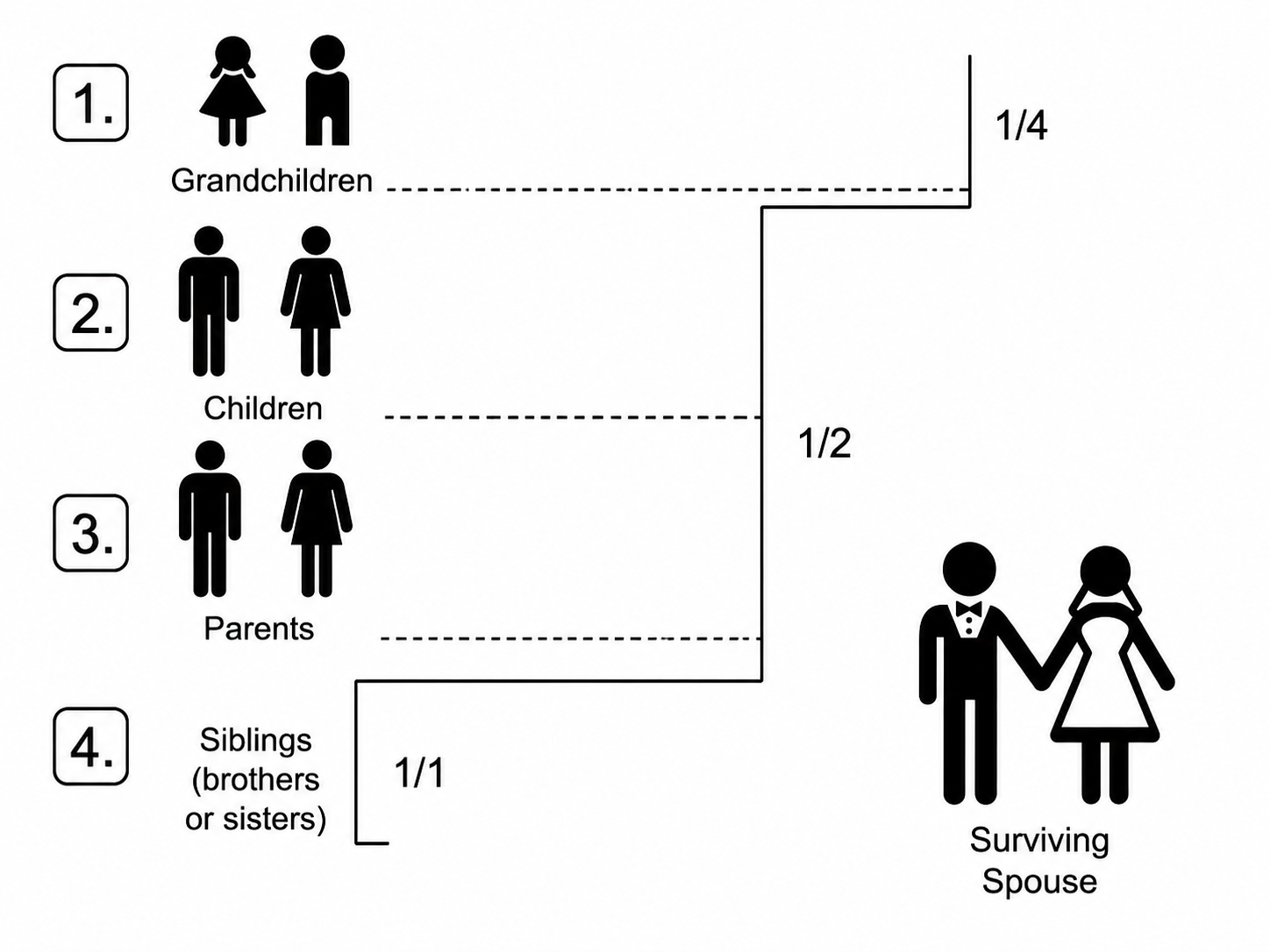
If the spouses have not entered into a marriage contract, the German statutory matrimonial property regime of community of accrued gains (Zugewinngemeinschaft) applies to the marriage and the succession, resulting in an increase of the spouse’s statutory share by one quarter (¼) by way of equalisation of accrued gains (Zugewinnausgleich). In this case, the spouse’s share may therefore increase to one half of the estate. If the spouses were subject to separation of property at the time of death and one or two children of the deceased are called to inherit alongside the surviving spouse, the surviving spouse and each child inherit in equal shares. Special provisions also apply to the matrimonial household.
The inheritance rights of the surviving spouse, as well as the right to the corresponding equalisation, are excluded if, at the time of the deceased’s death, the requirements for divorce were met and the deceased had filed for divorce or consented to it. Unlike under Spanish law, mere separation is not sufficient in this respect.
Our law firm will be pleased to assist you in analysing your individual circumstances, carrying out the necessary administrative procedures and assisting you with the corresponding tax returns. If you are interested or have any specific questions regarding this subject, please feel free to contact us by email or telephone.
Author:

Christoph Sander
Lawyer and Tax Advisor
CEO, Partner, Director
info@sspartners.es
Tel: (+34) 951 12 13 06
Facebook I LinkedIn I Amazon
Stay informed! Follow us on:


 (+34)
(+34)